
 Pet News

Summary
Senior dogs, much like elderly people, require special care and attention. With understanding and patience, you can ensure that your senior dog continues to live a comfortable, fulfilling and long life. This article will give you an overview of how senior dogs differ from their younger counterparts and how you can make adjustments that will accommodate their unique needs.
The early sun cast a pale glow on the quiet clinic as John and his aging companion, Bella, a once-black shepherd now frosted with age, entered. I greeted them, noting Bella’s labored gait, a whisper of the vigor she once possessed.
“Good morning, Bella,” I said, as she ambled towards me, a stoic figure marked by the passage of time. John’s face wore lines of concern, mirroring the decline in Bella’s once-sharp eyes and now-dulled hearing.
Bella stood patiently on the examination table, her trust in us evident even as her joints stiffened with arthritis. John’s hands never left Bella, offering solace as I gently probed, finding the lumps and bumps of old age. We discussed the testing and care for these growths, a common situation for seniors like Bella.
“We want to keep her comfortable,” I assured John, prescribing a diet for weight management to ease the stress on Bella’s body, and supplements to protect her aging joints and heart.
As they prepared to leave, Bella’s loyalty was as clear as the first day she had come through our door, a puppy full of boundless energy. Now, slow and deliberate, she still wore her devotion like a cloak, undiminished by the years.
“See you in a month, old girl,” I called after them, already anticipating the wag of Bella’s tail, an emblem of resilience and the enduring bond between a man and his dog.
Senior Dogs Defined
The definition of a Senior Dog will vary depending on the source. The American Veterinary Medical Association considers a dog to be a senior when it reaches the age of 6-8 years.
A more breed-specific definition is to consider a dog to be a senior when it reaches 25-30% of its expected lifespan. For example, the expected lifespan of a Labrador Retriever is 12 years, thus it is considered a senior when it reaches 8-9 years of age.
The expected lifespan of a Great Dane is 9 years, so it is considered a senior when it is 6 to 6 ¾ years of age. A Chihuahua isn’t a senior until it’s 10 ½ to 11 ¼ years old, since its expected lifespan is at least 15 years.

Nutritional Needs
As dogs age, their nutritional needs change. Here are some key points to keep in mind for your senior dog:
- Feed a high quality senior diet. Avoid grain-free diets, which have been shown to be associated with dilated cardiomyopathy in dogs.
- Senior dogs don’t digest food as well, resulting in decreased nutrient absorption.
- Senior dogs need adequate nutrients such as omega-3 fatty acids for joint health and antioxidants for keeping good brain (cognitive) function.
- Because they are often less active, make sure they are not getting too many calories including their meals and treats.
- They are also prone to unintentional weight gain due to their metabolism slowing down.
- Adding fiber to the diet can help with satiety (feeling full) as well as keeping stool firm and bowel movements regular.
Health and Veterinary Care
As your dog gets older, just like with an elderly person, it is important to have your veterinarian be a part of their health care team. Senior dogs should have checkups at least twice a year to catch any potential problems early, and to follow up on any issues that are on-going. If you consider the adage (loosely accurate) that one year equals 7 dog-years, then 6 months equals 3 ½ years for a dog. That’s not too often to see the doctor!
Things to keep in mind for your “well-senior-dog” veterinary visits include:
- Have complete blood screening done at least once a year. This includes a chemistry screen to check the kidneys, liver, and general organ function, a Complete Blood Cell count (CBC), and thyroid screen.
- Have a fecal screening done annually.
- Discuss vaccines with your veterinarian. The vaccination needs of your senior dog may change a little as they age, but usually stay the same. Occasionally pet owners opt to measure blood titers rather than vaccinate their very old senior dogs, which is a valid option, but takes some planning and added expense.
- Typically senior dogs continue monthly heartworm prevention, and receive flea, tick, and parasite control as they have been doing, provided they have remained healthy.
- Ask that your exam include digital palpation of the anal glands, which takes some time, patience, and may include a fee. This is because occasionally dogs will develop cancer of the anal glands. Your veterinarian may want to take your dog to the treatment room for this palpation to keep the anal gland odor away from the exam rooms.
- Ask your veterinary technician to scan your dog’s microchip to be sure it is present, hasn’t migrated (rare in mature dogs), and as a reminder to yourself to be sure you have it registered to your current phone number and address. If you do not have your dog microchipped, please do so now. MICROCHIPS SAVE LIVES! As your dog ages, their vision and hearing may deteriorate, and they become more susceptible to being lost or picked up by strangers, thus a microchip becomes even more important.
- Be open to and follow your veterinarian’s advice on dental care for your dog. It is highly likely your senior dog will need annual or semi-annual dental cleaning (unless they beat most statistics), which is very important to their overall health. (See the PHH article on Periodontal Disease).
- Ask about dental home care options for your dog. Teeth brushing, rubbing with gauze, or “finger brushing” (using a fingertip brush) are all good ways to improve pet dental health at home. (See the PHH article How to Brush Your Pet’s Teeth).
- Ask your veterinarian to carefully examine your pet’s eyes and ears, as senior dogs often have decreased vision and hearing loss as they age. Veterinarians can screen for cataracts or other eye problems during the wellness exam, and refer you to a veterinary ophthalmologist for further examination if there is any concern. Although diminished hearing can’t be evaluated with an otoscopic exam by your veterinarian, it is still good to examine your dog’s ears to rule out other ear problems at each visit, if your pet and time allow.
Advertisement
Exercise and Play
Exercise remains essential for the health and well-being of your senior dog, just as it has been for their health until now. The important thing is to modify their exercise as they age, both in intensity and duration. Shorter, gentler walks may be in order, rather than long, arduous excursions. Go 1-2 miles rather than 5-10 miles. If you have been using panniers on hikes with your dog, it is time to retire them.
More frequent, short walks to potty may be helpful for your senior dog as they age. Often senior dogs can’t hold their bladder as long as they used to. However, if you notice your senior dog urinating more frequently than normal, have them examined by their veterinarian, as this may be a sign of an infection or other problem.
It’s also a good idea to monitor your dog after walks to see if they become stiff and sore. Many owners think their dogs are doing just fine because they are peppy during walks. But many senior dogs will “overdo it” during walks, and suffer later from aches and pains. These dogs often benefit from anti-inflammatory medication such as NSAIDs.
Modify playtime as your dog ages, to decrease wear and tear on their joints, muscles, and ligaments. Many dogs love to play so much, they may hurt themselves from overdoing it. Substitute rough play like Frisbee, which is very hard on the dog’s whole body–especially their back and neck, with gentler games like running after a soccer ball on the ground. Some other ideas include: substituting tug-of-war with fetching a rope for a treat, and substituting catching a ball with running after a ball on the ground.
Keeping your senior dog’s mind stimulated with play even when their body can no longer play actively can still be fun. Dogs love puzzle toys and there are lots of different kinds available now, ranging from easy to challenging. Use tiny treats to keep the games going longer without stomach upset or weight gain; start easy and make things more challenging as your dog learns.
You can also hide treats around your home, in appropriate places within reach of your dog, or play hide and seek around the house. This is a fun, free game that will light up their eyes.
Joint Health, Mobility, and Pain
About 40% of senior dogs have clinically relevant osteoarthritis. This means that close to half of pet dogs, and probably most senior dogs, have arthritis that affects them in a significant way. The following supplements are generally recommended and helpful for dogs that are prone to or developing osteoarthritis:
- Glucosamine and chondroitin–these are protective for all the joints, and particularly helpful for dogs with a history of cranial cruciate ligament injury in their knees.
- Omega-3 fatty acids–these have an anti-inflammatory effect in the body and are helpful for many body systems, including brain, joints, skin, and coat.
- Adequan–an injectable (under the skin) polysulfated glycosaminoglycan (PSGAG) which improves joint health. Often given by veterinary staff in the veterinary clinic, some pet owners administer it themselves off-label.
Senior dogs often start to lose mobility as they age. Just like in elderly people, certain things become more difficult as their body becomes more stiff or their joints become arthritic. Watch them closely. Lately, have you seen them:
- Roll over onto their back?
- Stretch with their hind end in the air?
- Jump up into the car?
- Climb the stairs willingly?
- Run to greet you at the door?
- Leap onto your bed?
- Counter surf in the kitchen?
- Jump into your lap?
- Scratch their ears with their hind feet?
- Lick/groom their rear ends?
If it’s been a while since you have seen these behaviors, chances are that your senior dog is having some stiffness and soreness, which is natural at this age. This means it’s time to see your veterinary team and get some help. They are there to help get your friend back on track. Your dog can and should feel better.
Supplements can do a lot to help your dog feel better, and senior dogs should definitely be on the above supplements to help their joints if they are stiff and sore. But if you have noticed your pet stopping behaviors they used to do, they are showing you they have learned that these behaviors are painful. They are showing you pain by omission. If this is the case, it is time for a pain control trial with your veterinarian.
- Be sure your pet is already on glucosamine and chondroitin.
- Add Adequan (PSGAG) injections if possible, to protect their joints.
- Have your veterinarian run blood work to check your dog’s general health prior to starting medication.
- Your veterinarian may choose to start non-steroidal anti-inflammatories such as carprofen, deracoxib, or grapiprant. These are similar to Ibuprofen for people (which we never use in dogs) so must be used cautiously in our senior dogs.
- Or your veterinarian may want to start Librela™ (bedinvetmab), a once a month subcutaneous injection given at your veterinary clinic. This new medication targets nerve growth factor and interrupts the transmission of pain signals. It’s not processed through the kidneys and liver so it promises to be safer for our senior dogs, and is profoundly effective for pain control.
Advertisement
Home Adjustments
As your pet ages there are many things you can do to help make your home more senior friendly. Slippery floors become increasingly difficult for older pets to navigate. Area rugs are a good alternative to carpets, with rubber-backed mats for areas where pets need traction such as where they get on and off of furniture. Consider yoga mats if rugs are too expensive for long hallways or pathways through your home.
Every senior dog has reduced vision in dim light, just like senior humans. Add lighting to dim rooms,hallways and stairways, that your dog can rely on (such as lights on timers, or sensor lights that automatically turn on in dim areas).
Minimize stairs when possible. Use baby gates at the top or bottom of stairs to prevent unnecessary trips throughout the day. If your dog must use stairs, consider applying non-slip stair treads to improve their security and safety. They are inexpensive but make uncarpeted stairs much less slippery for your pet.
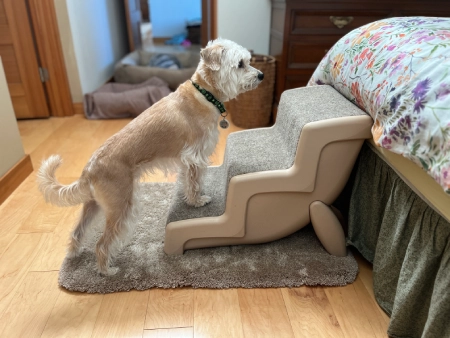
Use ramps and stairs to help your dog access furniture, your bed, and vehicles. Take some time with lots of treats to familiarize them with these new home aids, and be very patient. Most dogs will use them with practice.
Just like elderly people, senior dogs lose muscle mass over time. They become more sensitive to cold temperature, and less able to regulate their body temperature over time. They need softer and thicker bedding to be comfortable, so be sure to provide this for your senior dog as they get older.
If they are stubborn about laying on it, try training them with treats and even feeding them so they are positioned to lay on it. It may serve them well in the future if they learn to lay on soft, comfortable bedding in their early senior years.
Think Ahead About the Future
No one likes to think far ahead about the future when they have a senior dog. However, please, just for a few minutes, give it some thought. The reason is because of hospice care, bucket lists, memory books, and of course, euthanasia.
Most people start hospice care in the last week or two of their pet’s life. Hospice should start months before that, when your dog is first clearly very ill. That’s when all the great things that hospice has to offer can happen for you and your best friend. So when that day comes, please don’t hesitate–ask your vet, or comb the internet for a referral for someone to walk that path with you. It can be so much more beautiful than it has been in the past.
Make a bucket list for you and your dog. What do they like? Digging in sand? Buy a bag and dump it in the backyard for digging. Water? Get a kiddie pool and fill it up with warmed water. Cookies? Bake some and nibble on them for days. Your imagination is key and the sky’s the limit.
Make a memory book. Online, Polaroids, whatever suits you. Add a lock of hair, leave room for their tag, make a mud footprint, or paint, or ink. Add your hand print, or make matching nose prints. Do whatever makes you happy.
Sadly, we all must come to the decision about euthanasia for our senior dogs. It is mentioned here to think about for the future, because there are decisions to be made for planning. Do you want a home euthanasia, or in-clinic? Do you want cremation or burial in a pet cemetery? Do you want aquamation or cremation, and so on. Give these questions some thought, so that you can be prepared. (See our PHH article on Euthanasia for a more in-depth discussion.)
Working with your veterinarian, you will be making the best decision for you and your dog with the information you have available to you. Know and trust that no matter what decisions you make, your dog loves you unconditionally.


By Karen E. Mueller DVM, AVCA Certified
Dr. Mueller has over 30 years of experience in general small animal veterinary practice, feline medicine, and shelter medicine. Dedicated to preventing pain in pets and improving their quality of life, she currently has an animal chiropractic practice in Bellingham, WA. Dr. Mueller is also passionate about reducing pet overpopulation and works with high-volume, low-cost spay and neuter nonprofit programs throughout the Pacific Northwest.