
 Pet News


Summary
Cleaning your cat’s eyelids and eyes is a delicate process that requires patience, desensitizing, and careful handling. With your preparations complete and all necessary supplies at hand from Part 1, it’s time to learn the step-by-step methods to safely clean your feline friend’s eyelids and eyes.
This article will guide you through each phase to help you maintain the hygiene, health, and comfort of your cat. For cleaning compromised, painful eyes and eyelids, see Part 3 of this series.

The Cleaning Procedure
Before starting, it is crucial to recognize that your cat’s eyes and psyche are very sensitive, and mishandling can cause more harm than good. Your gentle touch, patience, and quick adaptability to your cat’s tolerance levels are the keys to a successful eye cleaning session, especially if your cat’s eye(s) and/or eyelid(s) require medication as well as cleaning, and are uncomfortable.
Determine if you need to clean discharge from the eyelids, or the surface of the eyes, or both. If both, clean the eyelids first, as they are less sensitive than the surface of the eyes (perform the most uncomfortable tasks last). For most cats, just their eyelids and face need to be cleaned.
While it is true that some cats will only give you one chance, for most cats you don’t have to finish the entire job in one go and can split it up over multiple sessions. If your cat has copious discharge that you can’t keep up with by cleaning once daily, it is time for your veterinarian to examine your cat.
Advertisement
Step-by-Step Guide
Setting Up the Environment
- Keep your cat calm! Your cat’s eyes are very close to its teeth, and both will be very close to your hands. Even the best cats can bite if they are stressed and scared. So remember to give your cat a sedative medication beforehand, if this has been prescribed.

- Make sure that your cat’s claws (all four paws) have been trimmed and that your hands are clean and your nails are short (nails no longer than ¼”).
- At least 30 minutes beforehand, find a quiet room away from other animals and plug in the Feliway® Optimum diffuser. If you don’t have time to do this, spray Feliway® Classic Calming Spray in the room 15 minutes beforehand. Also spray any restraint devices you plan to use.
- Consider giving your cat catnip, silvervine, or valerian root for a happiness booster, but not if they make your cat boisterous or aggressive.
- Make sure the room is a closed room, so that if your cat breaks free during the cleaning process, you won’t be searching a large area to find him again.
- Play soothing music to create a calm atmosphere for both you and your cat.

- Ensure all necessary supplies are within easy reach.
- Wash your hands (short fingernails!) thoroughly with soap, and rinse off all residue to avoid stinging your cat’s eyes with soap particles.
Restraint Techniques
- If you have a very mellow cat, you might only need your lap. If you don’t have a chill kitty, a restraint aid is needed.
- A second person can be helpful for extra support if needed.
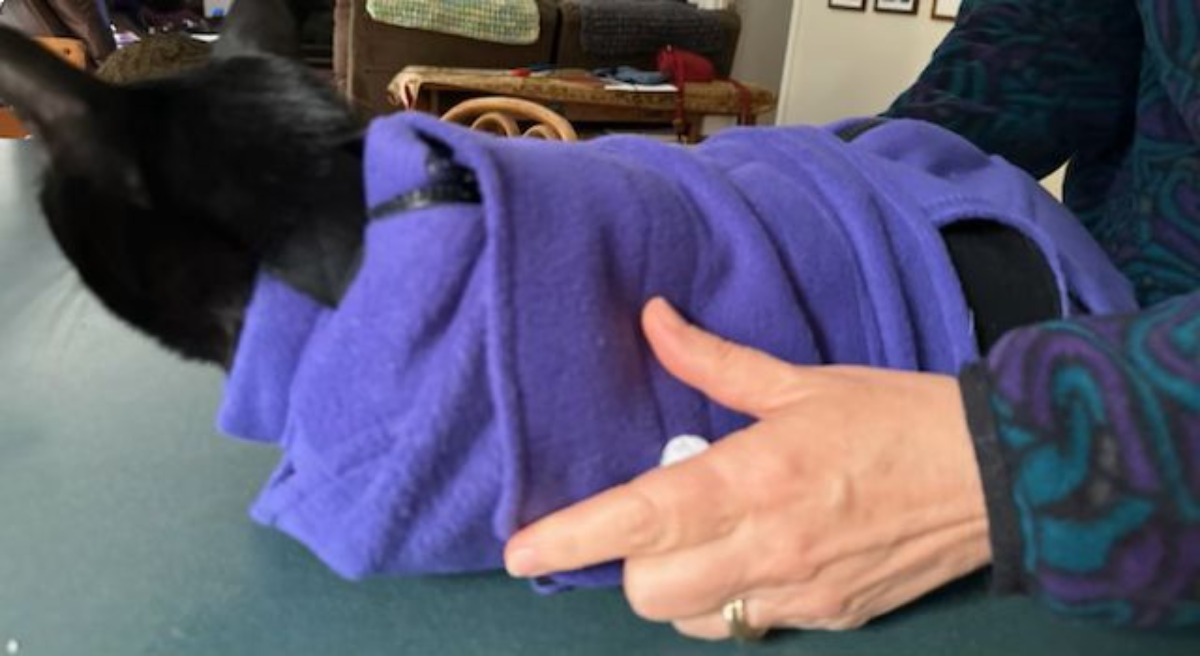
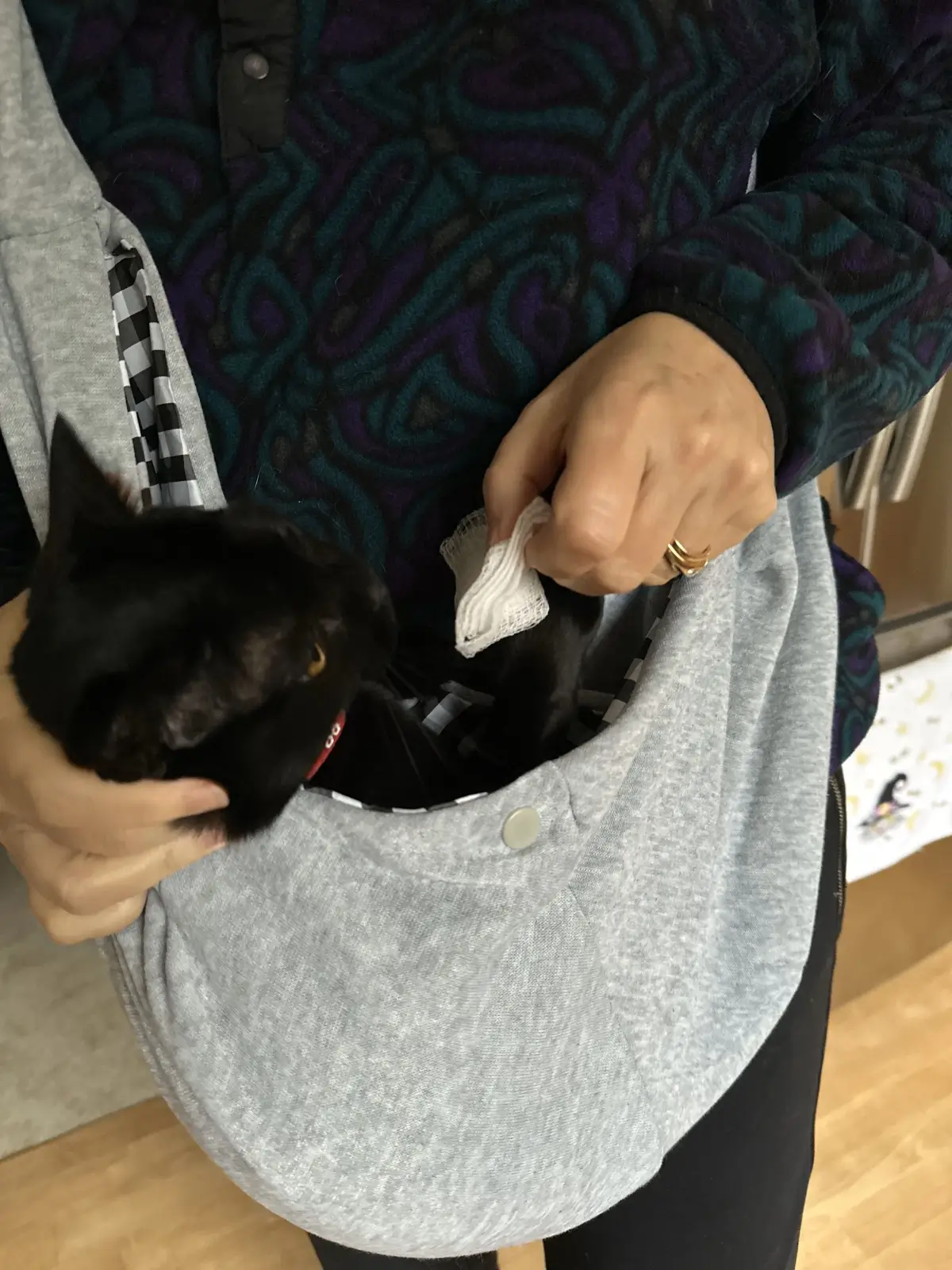
- If a restraint aid is needed: lay out a large towel (for cat wrapping), or a Calm and Cozy Cat Wrap on a table or on the floor (use a non-slip rubber-backed rug or mat, to make the surface more comfortable). Alternatively, cat sling carriers can work as minimal restraint for mild-mannered cats, if your cat feels safe and secure in the device.
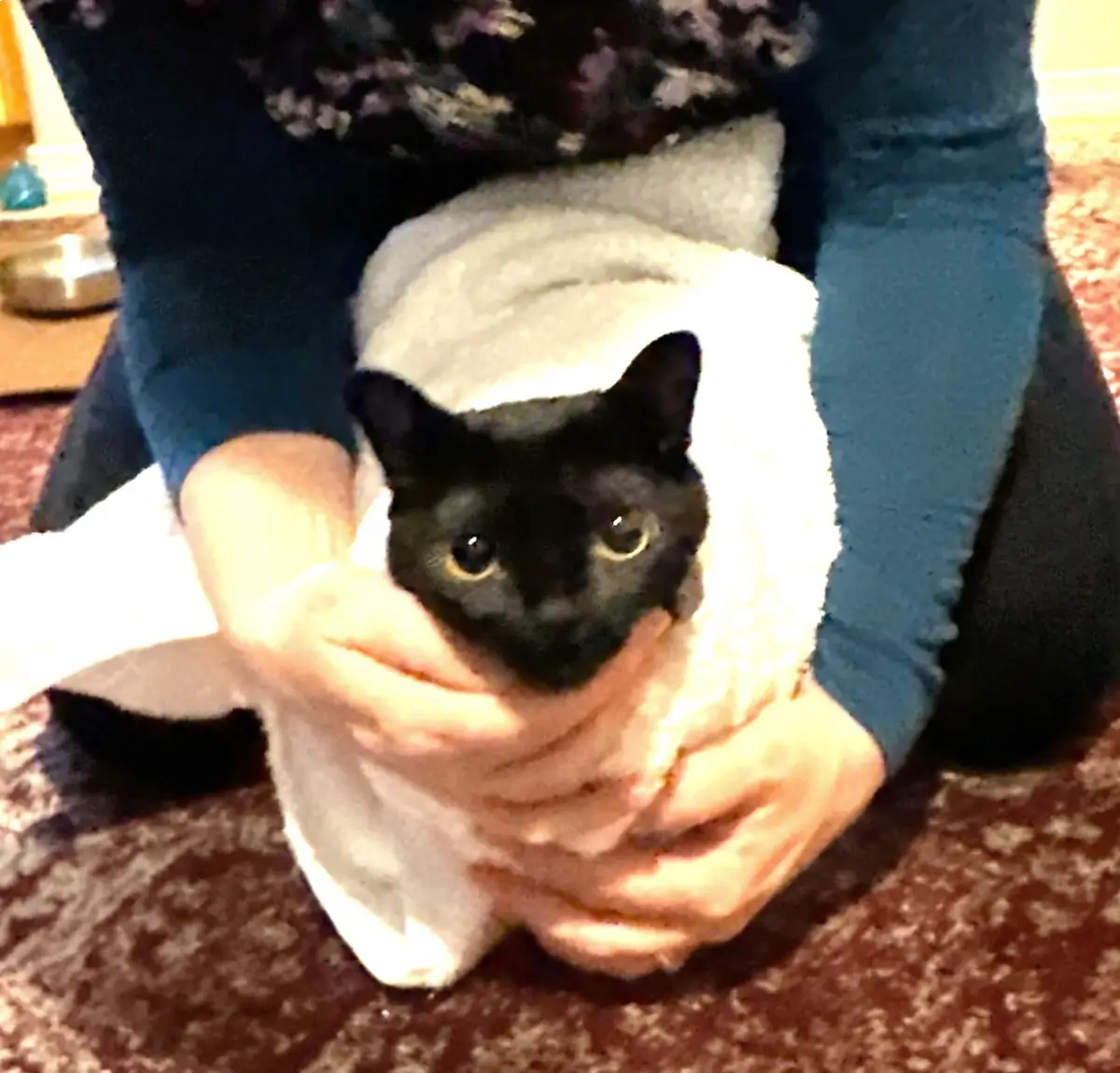
- If using a towel, wrap it around your cat’s body, leaving only the head exposed and the towel snug around the neck so that the cat can’t bring his front legs up and out of the wrap. This ‘kitty burrito’ approach helps both to soothe and prevent struggling. There is a trick to wrapping a cat, and it takes patience and some trial runs before you do it for real. There are several Youtube videos available on cat-wrapping, or have your veterinarian’s staff show you how to do this. Practice first with a stuffed animal, and then with your cat. If you have another very mellow cat, it is suggested that you first practice with this cat.
- If using a Calm and Cozy Cat Wrap, watch the video on the calmcozycat.com website to see how to use this great device.
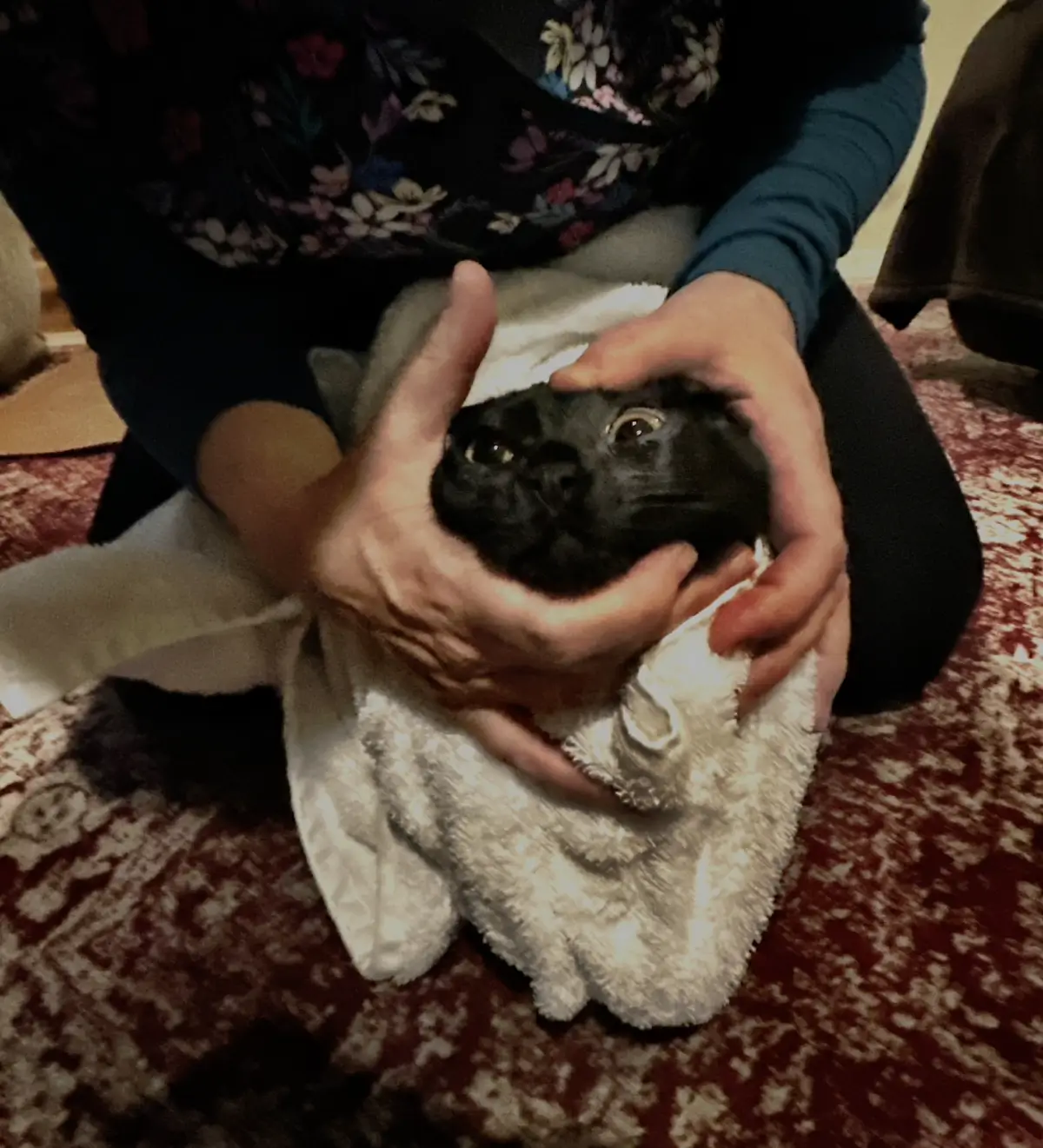
- After wrapping the cat with a towel or the Calm and Cozy Cat Wrap, it is often easiest if you kneel on the floor with your “kitty burrito” between your knees with the head facing away from you. Then you can cup your cat’s chin in one hand to elevate its head to best access the eyes and eyelids (he will then be looking up at you).
- If using a cat sling carrier, get your cat used to this device. Spray it beforehand with Feliway® Classic Calming Spray. Carry him around your house and give him lots of petting and treat rewards. Pet and stroke his face and around his eyes. (Trim his nails beforehand, or he might dig them into your side, through the sling fabric!). Then when you are cleaning his eyes/eyelids, it is very easy to tilt his head up (he’ll then be looking at you) to do the cleaning. With your cat cozily nested in the cat sling carrier, you might have a better ability to break up the process and do a little bit of cleaning at a time to reduce stress.
Pre-Cleaning Assessment
- If you notice a significant change in the eyelids or eyes (discharge, bleeding, swelling, severe squinting, or a change in color of the eye), contact your veterinarian’s office before proceeding, and take photos of your pet’s eyes and face to document what you are seeing over time, for your own information but also in case your doctor wants to review the photos (always take photos of BOTH eyes for comparison).
- If both the eyelids and the surface of the eyes need cleaning, it is usually best to clean the surface of the eyes last, as this is the most sensitive tissue and your cat might have less patience after the surface is cleaned. However, if your cat always has a short fuse, clean whatever is the most important first, knowing that you might need multiple sessions to get the job done.
Cleaning the Eyelids
- For removing discharge, moisten a gauze sponge with eye rinse solution (do not touch the tip of the bottle to the gauze) and gently wipe the discharge, wiping in a circular motion and outwards from the edge of the eyelid. Always wipe from the inside corner of the eye outwards and use a fresh gauze sponge for each eyelid.
- NOTE: If the discharge on the eyelid is also connected in one piece to discharge on the surface of the cornea, and the cornea is bulging/cloudy, STOP and seek veterinary care. The eye might have ruptured (typically from a cat claw laceration) and then temporarily sealed with a blood/fibrin clot that often looks like bloody mucus.
- If the discharge is dried, severe, and/or there are hard crusts and mats in the fur around the eyes, use Lid ‘n Lash® Vet (Pump gel or Wipes, but the gel is best in severe cases).
- For severe discharge and matted fur (especially if the underlying skin is raw and inflamed), the fur might be so stuck to the discharge that it needs to be carefully cut away.
- This might need to be done by your veterinarian under sedation.
- Use the gel to soften ‘chunks’ of crusts: squirt a large pea-sized blob on your finger (short fingernails are essential), then gently “paint” to coat the crusts with the gel. After waiting 5-10 minutes to allow softening of the crusts into “goo”, gently wipe away with a moistened gauze sponge.
- You might need to repeat this, as deeper “core” layers of crust soften.
- You might need to use a flea comb to tease out the softened crusts stuck to fur (see below).
- For lesser crusts, you can use the wipes: hold the wipe against the area for a moment to soften any hardened discharge before wiping away gently.
- After applying Lid ‘n Lash, a plastic flea comb (not metal) can be used to gently comb out the softened debris. Be cautious and keep the comb parallel to the eye surface to avoid injuring the eye.
- After wiping Lid ‘n Lash away, do not rinse, as Lid ‘n Lash helps clean the lids and reduce new staining of the fur (it will not reduce existing staining).
- It is OK if the Lid ‘n Lash product contacts the surface of the eye.
Advertisement
Cleaning the Surface (Cornea and Conjunctiva) of Healthy Eyes
Remember that the cornea is chock full of nerve endings, making it one of the most sensitive tissues of the body.
- Open the bottle of eye rinse and have gauze sponges ready. Place the bottle cap in a secure area where it can’t fall or be otherwise contaminated.
- Tilt your cat’s chin up (elevating your cat’s head makes your cat look down, exposing the white sclera above the limbus at the 12:00 position for easy access).
- Lift the upper lid and apply 1 to 3 drops of eye rinse onto the exposed sclera at the 12:00 position. Alternatively, you can roll out the lower lid, creating a pocket to which you can apply the drops.
- It helps to hold a gauze sponge or folded facial tissue under the lower eyelid in order to catch any fluid that overflows onto the face (most cats hate feeling an eye drop roll down their face, and they will react!).
- Gently open and close the lids a few times to help the rinse fluid spread underneath the lids.
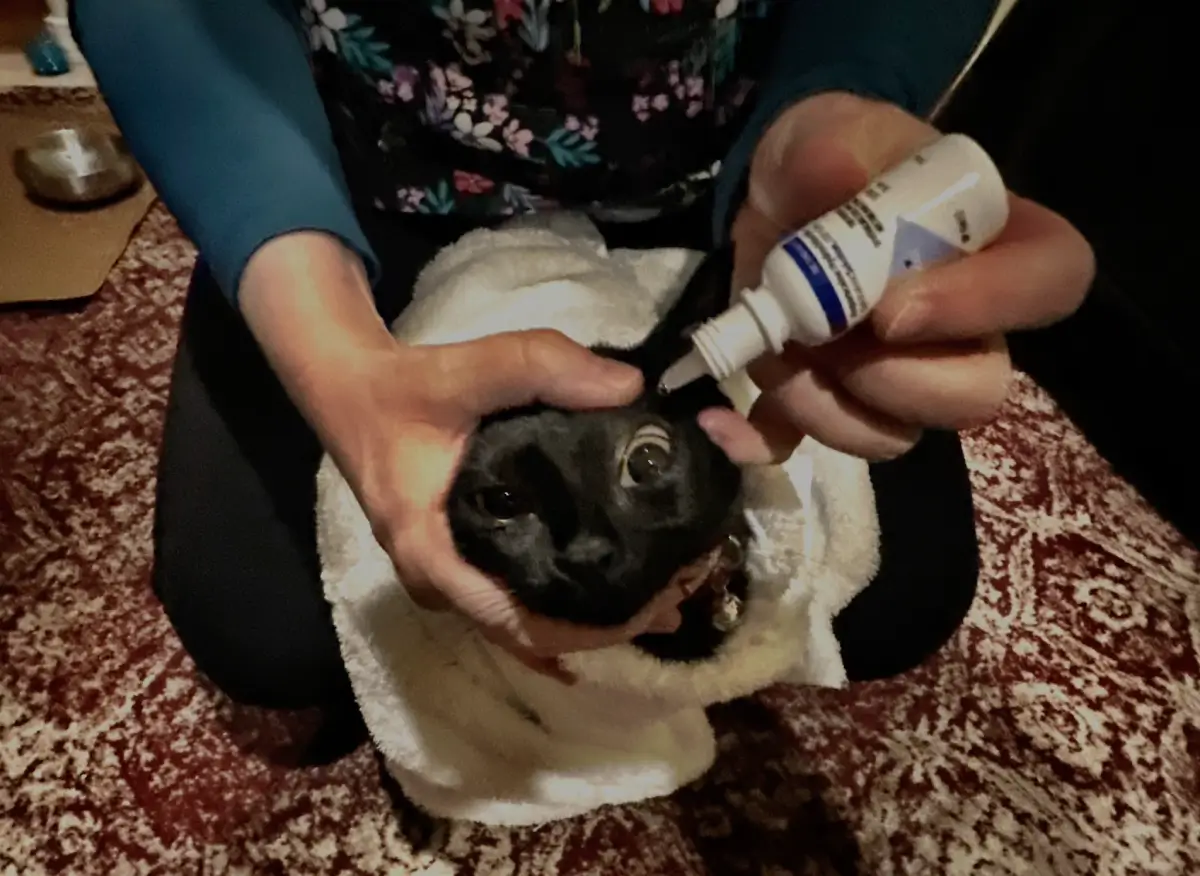


- The fluid helps “float” discharge off the surface of the eye and towards the edge of the eyelids. Then blot or “wick” the fluid and discharge from the inside corner of the eye with gauze sponges or facial tissue.
- Repeat as often as needed.
- Sometimes dried sticky discharge is trapped underneath the lids, and applying the eye rinse rehydrates and ‘plumps up’ the discharge, causing it to swell and escape from underneath the lids. In these cases, patience is needed to remove all of the expanding “goo” that keeps emerging from underneath the lids.
- To prevent contamination of the bottle’s tip, never touch anything to the bottle tip. Likewise, never touch the eye’s surface with gauze sponges, to prevent injury.
Advertisement
Post-Cleaning Care
- Offer praise, cuddling, and treats immediately after the cleaning session to associate the experience with a positive reward.
- Monitor your cat for any signs of discomfort or adverse reactions after cleaning, and consult with your vet if you have any concerns.
Cleanup and Hygiene
- Wash your hands after the procedure.
- Dispose of used gauze, wipes, and any other single-use items.
- Clean and store reusable items according to their instructions.
Advertisement
Troubleshooting and Tips
- If your cat shows resistance, pause and give her time to relax before continuing. Forced cleaning is sometimes necessary, but try to avoid this as it can lead to stress and possible injury (of you and/or your cat!).
- For multi-cat households, clean each pet’s eyes in separate sessions to avoid causing anxiety among your cats.
- Always keep the mood light and reassuring; talk to your cat in a calm voice throughout the process.
- If daily cleaning is necessary but is only temporarily needed, and your cat does not tolerate the procedure well, consider having your veterinarian’s staff do the job. Ask if you can watch them in action, so you can get some pointers.
- If cleaning will be long term, ask for a tutorial from the staff, and for them to video it for you to refer to.
Advertisement
Conclusion
Regular cleaning of your cat’s eyes and eyelids is often an essential part of their health routine, temporarily or lifetime. The steps outlined in this guide will help you perform this task safely and effectively. With practice, your cat will hopefully learn to trust you (but let’s face it—some cats have universal trust issues!), and eyelid and/or eye cleaning will become a straightforward task for both of you. Keep an ongoing photo log of your cat’s eyes for easy reference, and if eye problems persist or worsen, consult your veterinarian as soon as possible.
Remember, your calm demeanor during the cleaning process can greatly influence your cat’s response. Be patient, be gentle, and be vigilant in your care for your sensitive little furry friend. Your role in maintaining your cat’s eye health cannot be overstated. By combining the right techniques with patience and care, you’ll keep those peepers healthy and bright for a lifetime of curious glances and looks of love from the beautiful eyes of your feline friend.

By Terri L. McCalla BSc, DVM, MS, Diplomate ACVO
Dr. Terri McCalla Dr. McCalla received a BS in Animal Health Science from the University of Arizona, followed by her DVM degrees from both Oregon and Washington State Universities in 1984. She completed a 3 year residency in Comparative Ophthalmology from the University of Missouri and became board-certified in the American College of Veterinary Ophthalmologists (ACVO) in 1989.