 Pet News


Summary
Discover comprehensive information on cherry eye, a condition where the third eyelid gland prolapses in mammals, particularly dogs. Understand its causes, often linked to genetic factors, the symptoms, including inflammation and reduced tear production, and treatment options primarily involving surgical replacement of the gland. Learn about the prognosis and the association between cherry eye and dry eye syndrome. Knowledge on cherry eye can help ensure the health and comfort of your pet.
Zeus, a 4-month-old American Bulldog, was noticed one evening to have a red bulging lump in the corner of his right eye. As Zeus behaved normally and was exhausted after his long day at the beach, his ‘mum’ Eileen decided to see how he would be in the morning. The next day, Zeus appeared to be back to his old self—curious about the birds outside and ever vigilant about guarding the fridge door. Approximately a week later, Eileen awoke to find Zeus had the same red lump in the corner of his eye. When the lump hadn’t gone away on its own after a few days, Eileen’s concern grew. She worried that Zeus had injured himself or that a tumor was present, so she made an appointment for Zeus to see his veterinarian.
Zeus was thoroughly checked over by his veterinarian, who reassured Eileen that the red lump was the third eyelid gland that had become swollen and protruded over the edge of the third eyelid. Eileen later learned that the common name for a prolapsed third eyelid gland is a “cherry eye” due to its similarity in appearance to a cherry. Treatment options for Zeus were discussed, and surgical treatment to replace the gland was recommended. Nervous about the prospect of surgery for Zeus, Eileen decided to consult with a veterinary ophthalmologist to explore the latest information about possible non-surgical options for Zeus.
Read on for more information about Zeus’s treatment plan and response to therapy!
Introduction
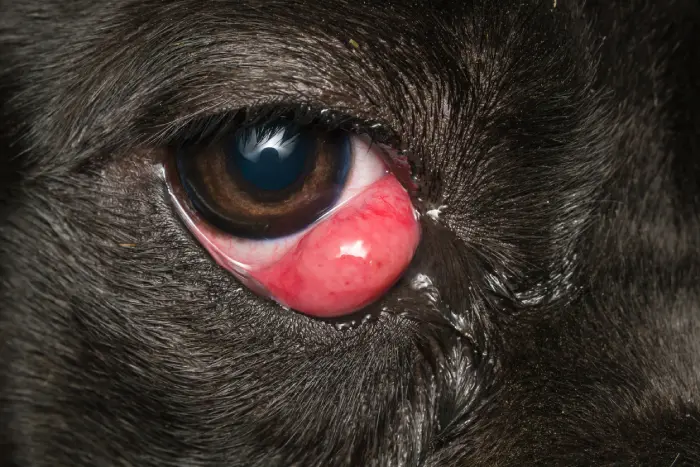
“Cherry Eye” [FIG 1] is a common term for the prolapse (or popping out) of the third eyelid gland. The third eyelid, also known as the nictitating membrane, plays a crucial role in the ocular health of most mammals, including dogs, by providing corneal protection and aiding in the spread of tears over the cornea.
The third eyelid gland, which normally resides on the side of the third eyelid closest to the eye, contributes about 30-50% of tear production. The term “cherry eye” stems from the appearance of the gland when it becomes inflamed and protrudes over the edge of the third eyelid – it looks like a red, smooth “cherry”. When the gland prolapses, it often affects one eye initially but may eventually involve both eyes.
Advertisement
What Causes Cherry Eye?
The exact cause of cherry eye remains poorly understood, but it is thought to be related to genetic factors present in predisposed breeds such as Basset Hounds, Maltese, Bulldogs, Cocker Spaniels, Lhasa Apsos, Pekingese, and Beagles. The inheritance of “cherry eye” is still under investigation but seems to be a condition found in families linked to certain genetic lines, possibly due to the shape of the third eyelid and the cartilage contained within it. Breeders are urged to exercise caution when breeding with affected dogs. Cats rarely exhibit the condition, with Burmese and Persians being the exceptions.
Cherry eye is thought to result from a weakness in the fibrous connective tissue attachment between the third eyelid and the surrounding eye tissues. It can also be associated with a bend or kink in the third eyelid cartilage, referred to as a scrolled cartilage [FIG 2], most often seen in large breed dogs.
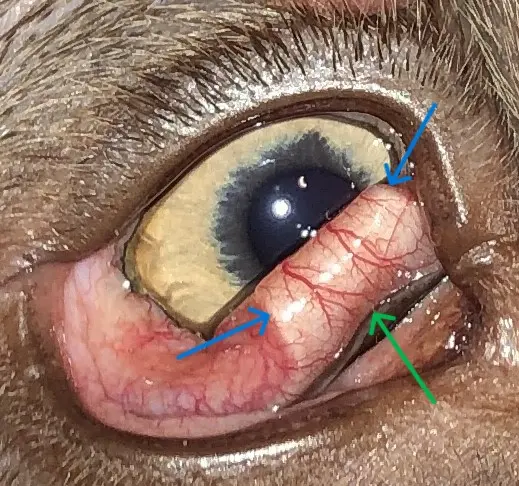
Dr. Marnie Ford Photo
While it’s primarily a cosmetic issue, a scrolled cartilage can cause conjunctivitis and increased tearing, potentially requiring surgical correction. While less common, cherry eye may be caused by orbital disease in older animals. More commonly, cherry eye affects young dogs aged between 4 weeks to 2 years.
Advertisement
What are the Clinical Signs of Cherry Eye?
The onset of gland prolapse can be sudden and often appears and regresses before finally persisting. Initially, the prolapsed gland will appear as a smooth pink-red lump in the inner corner of one or both eyes. Often the prolapsed gland is mistaken for a tumor or trauma.
Once the gland is displaced, it becomes inflamed and enlarged, potentially reducing tear production and making the eye susceptible to secondary bacterial infections. Persistent prolapse can lead to conjunctivitis, mucky ocular discharge, decreased tear function (‘dry eye’), and sometimes secondary corneal ulceration.
In chronic cases, pigmentation of the conjunctival tissue covering the gland can make it less noticeable. In older dogs, similar symptoms may suggest more severe issues like a mass behind the eye.
How is Cherry Eye Treated?
The presence of cherry eye is not purely cosmetic. Left untreated, cherry eye can lead to chronic conjunctivitis, ocular discharge, and reduced tear production, potentially resulting in keratoconjunctivitis sicca (KCS) or dry eye syndrome. This is because the gland of the third eyelid is responsible for producing up to 50% of the watery portion of the tear film.
Treatment involves the surgical replacement of the third eyelid gland, NOT its removal. Removal of the gland may quickly fix the problem, but it can lead to severe, painful, and expensive long-term complications associated with dry eye.
Studies have shown that surgical replacement of the gland can significantly reduce the incidence of dry eye (12%) compared to those who receive no treatment (40%) or have the gland removed (50%).
While the reduction in tear production from removed or repositioned glands may not be clinically significant in the short term, long-term studies have demonstrated that dogs undergoing surgical gland replacement had a significantly reduced risk of developing dry eye later in life (12% vs 40-50%).
Therefore, it is important to correct cherry eye (replace the prolapsed gland) to prevent chronic inflammation, discomfort, and potential vision impairment.
A cherry eye is not an emergency, but a quick replacement of the gland is recommended to prevent permanent damage to the eye or third eyelid gland. The initial treatment for prolapsed third eyelid glands involves topical antibiotic/steroid preparations, but this is usually only temporary, and recurrence is common.
These medications may help to reduce the associated swelling and inflammation (redness). The only option for permanently repositioning a persistent gland prolapse is surgery. Several surgical techniques have been developed to reposition the gland to its normal location, such as creating a pocket for the gland or anchoring it to surrounding tissues.
The Morgan pocket technique, or its many variations, is a popular surgical method. Your veterinarian will discuss the appropriate surgical technique that best suits your pet’s condition. The use of an E (Elizabethan) collar to prevent self-trauma is often recommended, especially if the gland is very large or damaged.
What’s the Prognosis?
In most cases, the gland returns to normal within a few weeks of surgery. Reprolapse of the gland is a possible complication, reported in 5-20% of cases, and may require repeat procedures. This complication has the highest probability in certain breeds like the Neapolitan Mastiff, American Bulldog, and Basset Hound.
Furthermore, the retention of the gland does not guarantee the prevention of dry eye, as these breeds are predisposed to both prolapsed glands and keratoconjunctivitis sicca (KCS). Many pets with a prolapse in one eye will eventually experience a prolapse in the other eye.
Despite these risks, surgical replacement of the third eyelid gland is always the first treatment choice due to the very high risk of developing ‘dry eye’ if the gland is surgically removed. In severe or chronic cases (or extremely rare cases of a tumor), there may be no option other than the removal of the gland, especially if its function is severely diminished or absent.

Zeus was evaluated by a veterinary ophthalmologist—me! Indeed, Zeus did have a cherry eye. Eileen had noticed that during the two weeks she waited for her appointment, the gland had spontaneously disappeared for two days, but then recurred and had slowly become slightly larger and redder since then.
I discussed the treatment options for Zeus with Eileen and agreed with Zeus’ veterinarian that surgical replacement of the gland would have the highest potential for successfully repositioning it. Topical medications aimed at reducing the size and color of the gland were only a temporary measure.
Zeus’ gland was surgically repositioned, and he was back home with Eileen the same day. Thanks to the diligence of my nursing staff, who were trained to keep Zeus safe while he was asleep for his procedure, his surgery and recovery went smoothly.
Apart from the short period following surgery when Zeus was required to wear a cone to prevent self-trauma while healing, he is looking better than ever and is back to being amused by the birds while diligently guarding the fridge door!
Conclusion
In conclusion, cherry eye is a condition primarily affecting certain dog breeds, caused by the prolapse of the third eyelid gland. While its appearance may initially be alarming, it’s essential to remember that this condition is not an emergency and is typically more uncomfortable for the pet than it is life-threatening.
However, early intervention and appropriate treatment, primarily through surgical replacement of the gland, are recommended to prevent complications like chronic conjunctivitis and dry eye syndrome.
The genetic factor in cherry eye’s prevalence among specific breeds underscores the need for careful breeding practices. With proper knowledge and timely veterinary care, the prognosis for pets with cherry eye is generally quite good, and they can lead comfortable, happy lives post-treatment.
By Marnie Ford PhD, DVM, Diplomate ACVO
Dr. Ford graduated from the Ontario Veterinary College in 2000 after completing a Bachelors in Zoology at the University of British Columbia and a PhD in Physiology at Monash University in Australia. Following a rotating small animal internship at the University of Minnesota in 2001, Dr. Ford achieved Diplomate status from the American College of Veterinary Ophthalmologists in 2006 after completing a 3-year residency in Comparative Ophthalmology at the University of Missouri. After co-founding a private referral hospital, West Coast Veterinary Eye Specialists, in New Westminster (2004-2013) she opened Pacific Animal Eye Specialty services, providing mobile medical and surgical ophthalmologic care to patients in the Lower Mainland, Vancouver Island, and the Interior of BC (2013-2019). In 2019, she returned to Australia where she worked full-time in both medical and surgical ophthalmology as well as resident training at Animal Eye Care in Melbourne Australia. In 2023, Dr. Ford returned to Vancouver to provide locum services to ophthalmologists across Canada.