
 Pet News


Summary
Anal sacs in dogs have served the purpose of marking territories in our pet’s wild ancestors. Located near the anus, they release a potent-smelling secretion during bowel movements. However, many dogs often face issues with these sacs, such as impactions, infections, and rarely, cancer. A prominent sign of an anal sac disorder is a pet scooting across the floor.
While many believe this behavior indicates worms, it’s commonly due to an anal sac disorder. Managing these issues might involve manual expression by a veterinarian, dietary modifications, or, in extreme cases, surgery. It’s essential to monitor your pet and consult a veterinarian for recurring or severe anal sac problems. This article expands on the causes and treatments of anal sac disorders.
In the clinic’s sterile light, anxiety reflected in Mrs. Johnson’s eyes, mirroring her terrier Max’s wary gaze. The scooting had returned, a problem we suspected was due to Max’s anal sacs. His tail was tucked in apprehension as I started the delicate examination. Max whimpered, and Mrs. Johnson winced, her concern for Max a tangible presence, coloring the air like the strong scent that marked his discomfort.
My reassurances to Max were as much for her as for him. As I met her gaze, I saw trust beneath the worry. Trust in my ability to bring relief to Max. Such moments, delicate balances of care and commitment, affirmed why I became a veterinarian – for the love of animals and the people who cherish them.
Introduction
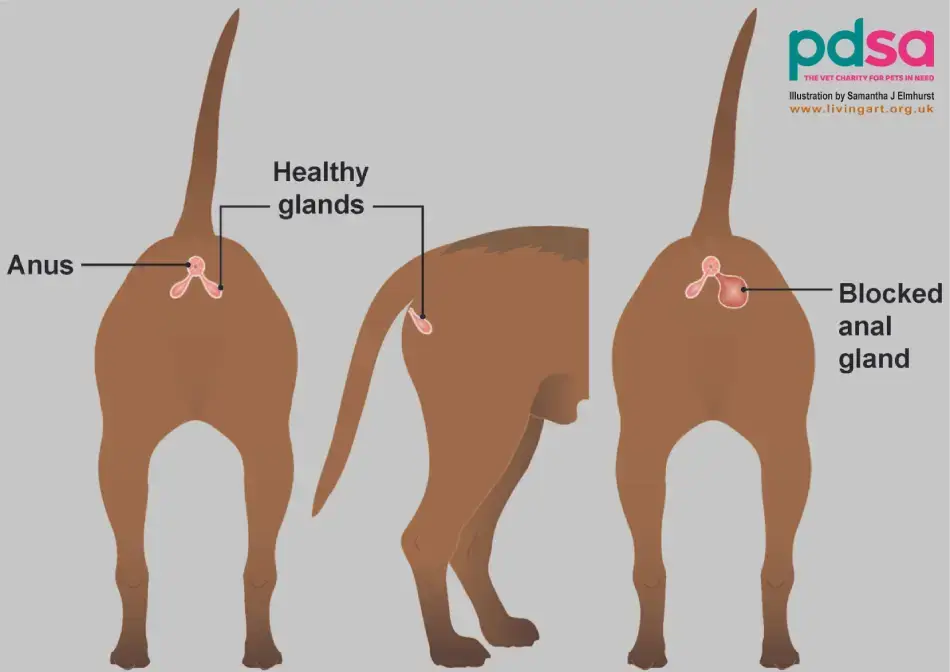
Anal sacs are kind of like the appendix in humans. They are organs left over from a time when they may have been needed—possibly for scent marking of territory when our pets’ ancestors were wild. They are 2 small sacs that hold strong-smelling secretions from glands near the anus, as their name implies. When all systems are working properly, a small amount of thin to watery secretion is expressed from the sacs with each bowel movement. However, like the appendix in humans, anal sacs often cause trouble in dogs.
Advertisement
Common Problems with Anal Sacs
Anal sacs are prone to a number of problems, including impaction, infection (sacculitis), and neoplasia (cancer). Fortunately, impaction is by far the most common problem, and cancer is fairly uncommon, although it must be on every veterinarian’s rule-out list, and is an important reason why you should have your pet seen by your veterinarian when anal sac problems arise.

Symptoms of Anal Sac Disorders
One of the most common symptoms of anal sac problems is scooting on the floor. Dogs will usually choose a particular surface to scoot along (often your favorite carpet!), chosen for the texture to rub their sore or itchy bottom against. Although many people think that scooting means a pet has worms, usually it means a pet has anal sac problems.
Other symptoms of anal sac disorders include scratching at or near the anus, licking at the anus or base of the tail, hesitancy or straining to defecate, and not wanting to sit or lift their tail.
Advertisement
Anal Sac Secretion
Anal gland secretions are strong-smelling. Maybe not as strong as a skunk, but still very strong nonetheless. One of the ways you might notice your pet has an anal gland problem is by detecting this very strong odor. It can be foul-smelling, somewhat fishy, and hard to get rid of. Washing your dog’s hind end with pet shampoo might be necessary to get rid of the odor. Be especially gentle though, because their anal area is likely to be very tender when they are having anal sac issues.
Impacted Anal Sacs: Causes and Treatments
When the anal sacs are not expressing properly with each bowel movement, they can become impacted. This can happen due to soft feces or diarrhea, when they are creating excessive secretions (due to unknown causes) or when they have skin disorders that change the makeup of their secretions.
When anal sacs are impacted, they can become very uncomfortable to downright painful for both dogs. Often a veterinarian can relieve impacted anal sacs by digital expression, usually by inserting a gloved finger rectally and compressing the anal sac between their finger and thumb. Many pets will tolerate this procedure with surprising grace. If the pet can’t or won’t tolerate it, they may need to be sedated or anesthetized (fully asleep) so the veterinarian can accomplish the task. The anal sacs may then need to be flushed in order to soften their secretions before expression.
Dietary Modifications to Aid Anal Sac Health
Some pets are troubled by recurring anal sac impactions. For these pets, modifying their stool consistency can be very helpful. The best way to do this is through adding fiber to their diet. Adding canned pumpkin is one easy way, and most dogs like it.
A common starting point is 1-2 tablespoons per day for small dogs, and this amount can be frozen in ice cube trays to prepare ahead for daily feeding. For larger dogs, 1/4 cup per day may be a good starting amount. You’ll have to find a dose that works for your pet, as too much can cause loose stools or be constipating for some dogs.
Beware with dogs that vomit often, as pumpkin will stain carpets and furniture. If your dog doesn’t like canned pumpkin or tends to vomit, you can try Vetasyl fiber capsules instead, for a good source of fiber. Another good option for both dogs is Hill’s Science Diet W/D, a prescription diet very high in fiber.
Feeding a percentage of your pet’s diet, say 20% to 25% W/D, can help the stool bulk up enough so it expresses the anal sacs better, and helps avoid their impaction.
Anal Sac Infections and Abscesses
Anal sac infections and/or abscesses are fortunately less common than impactions but they are still relatively common. The symptoms are the same as previously described, but sometimes more pain is shown by the pet, and some bloody discharge is seen by the owner in the area near the anus. Occasionally the pet owner will see small sores below and to either side of the anus, where abscesses may be draining.
Anal sac impactions may lead to infections and abscesses but it is difficult to be sure of the exact cause. They are usually treated by expressing the anal sacs, with or without sedation and/or anesthesia depending on what the dog will allow, in addition to appropriate oral or injectable antibiotics.
The veterinarian may also choose to infuse antibiotics and/or steroids into the anal sacs to help with healing and inflammation. Most commonly, anal sac infections will clear up with a course of antibiotics and in most cases will not recur.
Advertisement
Anal Sac Cancer: Signs, Diagnosis, and Treatment
Occasionally, cancer of the anal glands does occur in dogs. Symptoms of cancer present much like impacted or abscessed anal sacs. Symptoms may respond well to treatment initially, similar to benign cases.
However, if there is a cancerous tumor associated with the anal gland itself, the symptoms of discomfort will usually recur after initial treatment. A biopsy is indicated as soon as possible if cancer is suspected, in order to get a definitive diagnosis and initiate appropriate treatment.
It is very important to follow up treatment with re-checks if advised, and especially if your pets’ symptoms recur. Cancer, especially if caught early, can be successfully treated in many cases. Your veterinarian may refer you to a board-certified surgeon, and/or a veterinary oncologist for specialized cancer treatment to help give your pet the best possible outcome.
Surgical Consideration for Chronic Anal Sac Issues
You might ask, if anal sacs are such a problem, why don’t veterinarians remove them more often, like the appendix in humans? The answer is that it can be both an expensive and a tricky surgery to perform. Most general practitioners prefer not to do the surgery, which means you would likely need to seek the services of a board certified surgeon, which may be beyond the means of many pet owners.
Also, the perineal region (around the anus) is innervated with all the important nerves that control the anus itself as well as important muscles of the hind end. Problems that might occur in surgery while dissecting around the anal sacs include injuring those nerves, possibly resulting in issues with continence (bowel movements) and even difficulties with motor function. Thus removing the anal sacs for recurring impaction is not a surgery that is commonly advised.
That said, you are certainly invited to discuss surgery with your regular veterinarian, and discuss the pros and cons. If your canine friend is miserable on a frequent basis, it is definitely worth discussing.
Advertisement
Prevention and Routine Care for Anal Sacs
In terms of prevention, people often wonder if they should have their normal dogs’ anal sacs expressed just for good measure, even if they are not showing any signs of a problem. There is no need to have a normal pets’ anal sacs expressed if they are not showing any symptoms of a problem.
Groomers have mostly stopped doing routine anal sac expression and this is a good trend. In general it is wise to avoid squeezing tissues that have the potential to become inflamed and infected. For dogs that have a strong history of impaction, routine expression may be advisable, but this is best addressed on a case-by-case basis.

By Karen E. Mueller DVM, AVCA Certified
Dr. Mueller has over 30 years of experience in general small animal veterinary practice, feline medicine, and shelter medicine. Dedicated to preventing pain in pets and improving their quality of life, she currently has an animal chiropractic practice in Bellingham, WA. Dr. Mueller is also passionate about reducing pet overpopulation and works with high-volume, low-cost spay and neuter nonprofit programs throughout the Pacific Northwest.