 Pet News


Summary
This article offers a detailed examination of how animals perceive their environment, contrasting their visual abilities with human sight. The article covers aspects such as visual acuity, the influence of pupil shape, and the adaptation of light and motion perception across various species. It also discusses the significance of field of view and color vision in animals.
Emphasizing the diversity in visual capabilities among different species, the piece concludes that each animal’s vision is uniquely tailored to its ecological needs, highlighting the specialized nature of visual perception in the animal kingdom.
Introduction
Hey Doc, how well does my dog see? Such a simple question, but an answer that is more complex than one might think. There are two key facts to state up front. First, vision in animals is not the same as vision in humans. Many factors contribute to the visual experience and the strength of each factor varies among animals.
Second, what animals see is a direct function of what information reaches the brain for interpretation. The eyes do not ‘see’ in the traditional sense. They are simply receivers of environmental information. This information is sent to the brain, where the ‘picture’ is assembled and processed. Put simply, we “see” with our brains, and not with our eyes.
Advertisement
Visual Acuity
When we ask about vision or how well we see, we are usually asking how good our visual acuity is, or, how well we distinguish two close objects separately and unblurred. Visual acuity plays a prominent role in the human visual experience but is only one aspect of vision for all animals including humans.
The complete visual experience, for both you and your pet, comprises many components. Besides acuity, these include the ability to perceive light and motion, visual perspective, field of view (FOV), depth perception, and color vision.
You and your pet utilize all of these components; however, the extent that each is used is different and varies by species and breed. It is natural to assume that because visual acuity in humans far exceeds that of most animals, that the human visual experience is superior to that of other animals.
You will learn that the other components of the complete visual experience are much more impressive in animals than in humans. Believing that a tiny camera attached to an animal’s head can reveal its visual understanding is absurd. At most, this camera might offer insight into the animal’s environmental perspective, but nothing beyond that.
When we ask about vision or how well we see, we are usually asking how good our visual acuity is, or, how well we distinguish two close objects separately and unblurred. Visual acuity plays a prominent role in the human visual experience but is only one aspect of vision for all animals including humans.
The complete visual experience, for both you and your pet, comprises many components. Besides acuity, these include the ability to perceive light and motion, visual perspective, field of view (FOV), depth perception, and color vision.
You and your pet utilize all of these components; however, the extent that each is used is different and varies by species and breed. It is natural to assume that because visual acuity in humans far exceeds that of most animals, that the human visual experience is superior to that of other animals.
You will learn that the other components of the complete visual experience are much more impressive in animals than in humans. Believing that a tiny camera attached to an animal’s head can reveal its visual understanding is absurd. At most, this camera might offer insight into the animal’s environmental perspective, but nothing beyond that.
Acuity is a key component of the visual experience. When we talk about vision or how well we see, we often refer to our visual acuity. This means how well we can distinguish two close objects as separate and unblurred entities. Although visual acuity plays a prominent role in the human visual experience, it’s only one aspect of vision for all animals, including humans.

By utilizing the optics of the eye, the retina, and the brain to interpret what is being seen, visual acuity can be measured. In humans, this is often done using a Snellen Eye Chart. You might recognize this as the chart with letters, numbers, or shapes commonly seen in a doctor’s office. Normal human eyesight is expressed as a fraction, the Snellen Fraction.
The chart uses symbols of diminishing size to measure our ability to distinguish between them. For example, a patient with 20/20 vision sees at 20 feet what someone with normal vision sees at the same distance. In contrast, a patient with 20/40 vision sees at 20 feet what a person with normal vision sees at 40 feet.
But how is visual acuity measured in animals, infants, or non-communicative humans who can’t use an eye chart? One method is retinoscopy, which involves identifying the strength of a diagnostic lens required to focus an image onto the retina. This process helps determine the eye’s optics. Though not as precise as direct measurement, observing an animal’s behavior, such as following a moving object or reacting to a menace response, can provide crude estimates of visual acuity.
However, a positive response in these tests might still be present even if visual acuity is less than 20/800, a level considered legally blind in humans.
Interestingly, visual acuity varies significantly across species. For instance, owing to the distribution of photoreceptors in the retina and the shape of the lens and curvature of the cornea, visual acuity is different among various animal species.
Generally, it’s widely accepted that, in order of best to worst acuity, the ranking is as follows: diving birds, humans, horses, dogs, and finally cats. This ranking shows that while humans have good visual acuity, some animals, like diving birds, surpass us in this regard.
While visual acuity is crucial for humans in activities like reading and driving, it’s less critical for many animals. Their lifestyle relies more on other senses and types of vision, emphasizing the diverse nature of visual experiences across species.
Advertisement
Pupil Shape and Position

Another factor that influences how an animal navigates its environment is the shape of the pupil. There are four basic pupil shapes: vertical, subcircular, circular, and horizontal. For simplicity, we will group the subcircular and circular pupil shapes into one category and call it a round pupil. The vertical pupil and the round pupil are generally present in predator animals (e.g., cats, dogs, humans), whereas horizontal pupils are found in prey animals (e.g., cows, horses, goats, sheep).
There are some exceptions to these (e.g. rabbits and rodents are a prey animal with round pupils). The predators can be subdivided into those who actively forage for and then chase down their prey (e.g., big cats, dogs), and those who ambush their prey after waiting almost motionless (e.g., domestic cats).
The difference in pupil shape not only affects the speed and extent by which a pupil can dilate and constrict to best exploit the day or night lighting, but also how much of the visual field can be seen in three dimensions (3-D).
Animals with forward facing eyes are usually predators and almost always have vertical or round pupils. This forward-facing orientation provides an increased area of binocular vision and in turn increased depth perception.
Animals with eyes on the sides of their head are nearly always prey animals with horizontal pupils. With minimal binocular vision, this pupil shape affords a better ability to scan the horizon and utilize motion parallax to determine depth. Motion parallax is a depth perception cue in which near objects seem to move faster than objects that are further away as the viewer moves past them.
Accommodation
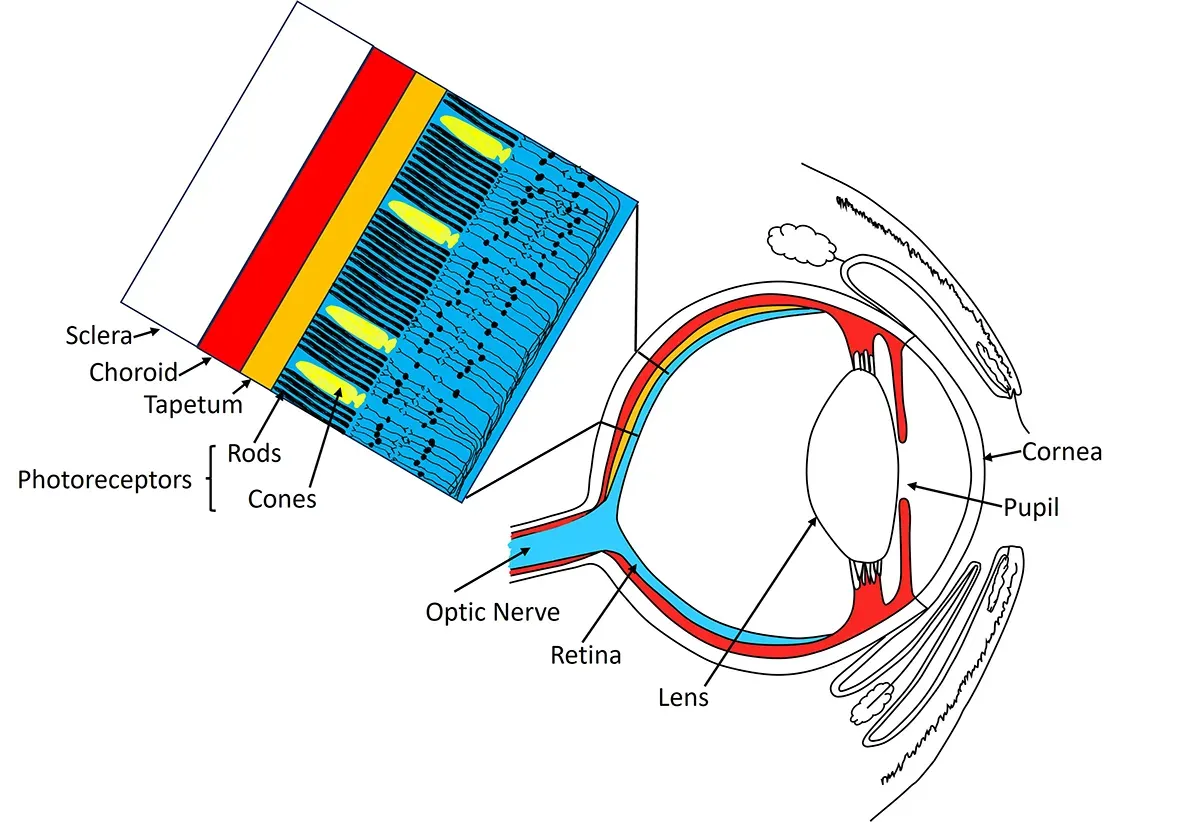
Accommodation, a subcategory of visual acuity, is the focusing ability. That is, the ability to bring objects into focus without moving closer to or farther from the object. The ability to focus, or accommodate, is influenced by several factors. These include the optics of the eye, such as the lens’s size, shape, and position relative to the cornea and retina.
It also depends on the efficiency of the retina’s photoreceptors in converting light to electrical signals and the brain’s ability to interpret these signals. This ability is largely dependent on how flexible the lens is and as such, varies between all individuals.
As we age, our lenses become stiffer (lenticular sclerosis, or nuclear sclerosis) and less able to accommodate – this is why we need reading glasses when we get older!
In addition, our ability to see at night becomes less and makes it more difficult to drive at night. Accommodation is limited in domestic animals and may explain why these animals use other senses (smell or taste) to investigate very near objects.
Just like humans, however, the lens of an animal also becomes stiffer with age and may be one reason why some animals are more reluctant to go outside at night or are noted to trip or stumble more in dim light than during the day. Another reason is the age-related progressive loss of rod photoreceptors, which are most sensitive to low light levels.
Advertisement
Light and Motion Perception
The ability to perceive light in most animals far exceeds that of humans. Unlike humans, most animals have more rods, a tapetum (the “eye shine” mirror in the back of the eye) which is present in all animals except for birds, rodents, pigs, and primates (including humans), and have physical adaptations that include a larger cornea and a pupil that can dilate (enlarge) more than that of humans to allow more light into the eye.
Animals and humans are more sensitive to motion than to stationary objects. However, the circumstances by which this sensitivity is apparent depends on the surrounding light. In bright light, a human’s ability to perceive motion is greater than that of most animals, and in dim light, most animals’ ability to perceive motion is greater than that of a human.
The disparity in motion detection that is dictated by lighting conditions is related to which type of photoreceptor dominates the retina, and their distribution within the retina.
Humans have a fovea, which is a focal region of highly concentrated cone photoreceptors that are highly sensitive to motion in bright light and as such, are used for day vision (think of eating ice-cream CONES during the day).
Most animals, on the other hand, have a more diffuse but highly concentrated number of rod photoreceptors that are more sensitive to low light levels, and are used for night vision (think of hot-RODding at night). It cannot be stated that having more rods or more cones is better than the other; the differences in the number of rods or the number of cones is best for THAT animal species.

The perspective we have of our surroundings is greatly influenced by the height of our eyes above the ground. This can vary considerably between different species, such as cats versus horses. Variation in eye height above the ground is minimal between adult animals within the same species, apart from one notable exception – the dog.
Height of the eyes above the ground for dogs varies considerably between different breeds! This height variation allows each species to not only exploit their specific niche but contributes to their interpretation of the environment and even to some behavioral traits.
Field of View

The field of view (FOV) is the area that can be seen by one or both eyes when it is fixed on one point. The FOV of one eye is called the monocular FOV, the overlapping view of the two eyes is called the binocular FOV, and when the views of both eyes are considered together as a whole, it is called the total FOV.
Animals with eyes that are positioned further apart (e.g., rabbits, horses, cattle, and some dogs) have a greater total FOV but a smaller binocular FOV and consequently, reduced depth perception. In contrast, an animal with forward facing eyes (e.g., human, cat, and some dogs), has a smaller total FOV but a much wider binocular FOV and consequently, greater depth perception.
The position of the eyes is directly influenced by the shape of the skull. While most individuals within a single species (e.g., all horses, all cats, and all cows) have little variation in their skull shape, the variation in skull shape between different breeds of dogs is extensive.
The binocular FOV is just one of many factors that contribute to depth perception. In other words, binocular overlap contributes to but is not a requirement of depth perception.
It is a misconception to believe that two eyes are required for depth perception! Unless you only have one eye, two eyes view the world from slightly different vantage points and the image is fused in your brain into one single image. This is called stereopsis which enhances, but is not a requirement of, depth perception.
Depth perception is a function of many other factors that include relative brightness, contour, areas of light and shadow, object overlay, linear and aerial perspective, and density of optical textures. We are utilizing all of these observations without even knowing it!
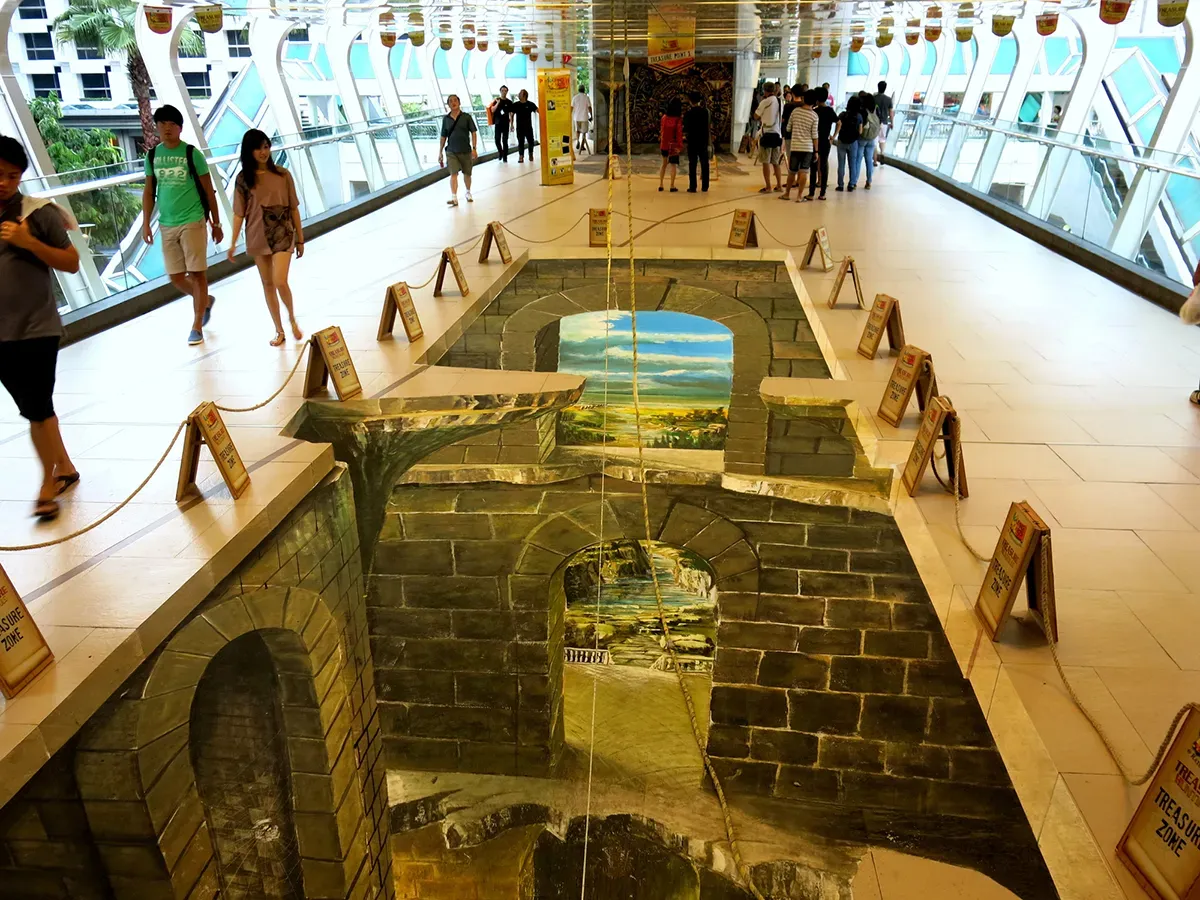
A good example of this is to think about a quality two-dimensional (2D) chalk sidewalk drawing…you perceive the image to have depth based on the contours, areas of light and shadow, overlapping chalk marks, perspective, and textures but you do not require having two eyes to appreciate this; just shut one of your eyes to prove this to yourself.
The shape of the pupil also affects the FOV. Animals with forward facing eyes are nearly always predators with vertical or round pupils. This forward-facing orientation provides an increased area of binocular vision and in turn, depth of field. The increased depth of field allows ambush predators (e.g., cats) the ability to focus on an object without having to move and potentially scare away their prey.
Animals with eyes on the sides of their head are nearly always prey animals with horizontal pupils. With minimal binocular vision, this pupil shape affords a better ability to scan the horizon to watch for predators and utilize motion parallax to determine depth.
Advertisement
Motion Parallax

Motion parallax contributes to depth perception. It is the ability to perceive one stationary object in front of or behind another stationary object by moving past them. By moving past two stationary objects that are positioned at some distance from each other, the closer object will appear to “move” faster than the more distant object.
This concept can be easily understood while driving in your car or sitting on the train. While looking out the window of a moving train, the objects close to the road (e.g., fence posts) next to the train tracks you are travelling on appear to be moving faster and move in the opposite direction to your travel, while the objects further away (e.g., distant mountains) do not appear to be moving at all or even moving slightly in the same direction of travel.
Objects in between the very near or the very distant objects move variably, depending on whether they are closer to or further from the nearest objects.
All animals, including humans, use motion parallax subconsciously to judge distance. This is especially true in animals with a very narrow binocular FOV like horses or cows. Rather than run at great speed to judge if objects appear to be moving fast or slow, these animals can be seen to bob their heads up and down to judge if an object (e.g., a fox) is in front of, or behind, another object (e.g., a fence line).
Color Vision
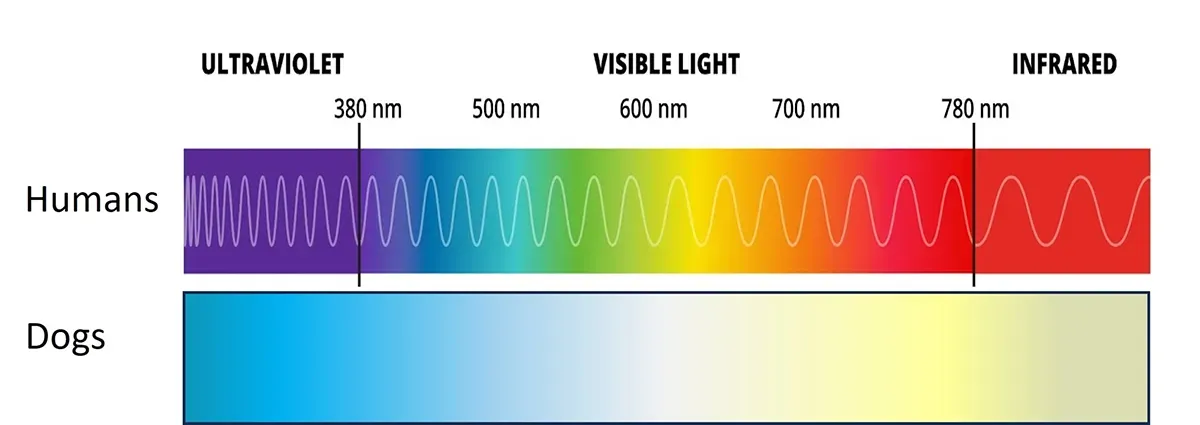
The extent of color vision is not fully understood for all species of animal. We do know that the number of cone color receptors varies between different animals and as such, the range of colors perceived by different species varies.
Where reduced color detection is present, an animal must rely on other clues such as position, relative brightness, smell, taste, and texture to identify objects. While most humans can detect a range of color that extends from the violet to yellow wavelengths, birds can see past this into the ultraviolet range of wavelength.
Before you feel too bad for some animals and their reduced color vision; unlike humans, these animals can perceive many more shades of gray that are imperceptible to humans and as such, have a greater quality of low light vision.
Advertisement
Conclusion
Vision plays an important role in the lives of all animals by helping them to interact with and thrive within their environments. Each component of the complete visual experience varies between animals and has been evolved to exploit the specific niche within which that animal lives.
While certain components of the complete visual experience may excel in some species of animals over others, comparison and ranking of the total visual experience between animal species cannot be made.
Every species, whether human or animal, has evolved so that the vision they have is perfect for THEM. For example, vision for a cat is not inferior to that of a human. It is perfect for being a cat and seeing what cats have evolved to NEED to see and HOW to see it.
For further information please visit How and What Dogs See, and What Cats See, where we will explore the same concepts as those above but in greater detail, as well as Vision in Dogs (1995) Journal of the American Medical Association, 207(12): 1623-1634 by Miller PE and Murphy CJ.
By Marnie Ford PhD, DVM, Diplomate ACVO
Dr. Ford graduated from the Ontario Veterinary College in 2000 after completing a Bachelors in Zoology at the University of British Columbia and a PhD in Physiology at Monash University in Australia. Following a rotating small animal internship at the University of Minnesota in 2001, Dr. Ford achieved Diplomate status from the American College of Veterinary Ophthalmologists in 2006 after completing a 3-year residency in Comparative Ophthalmology at the University of Missouri. After co-founding a private referral hospital, West Coast Veterinary Eye Specialists, in New Westminster (2004-2013) she opened Pacific Animal Eye Specialty services, providing mobile medical and surgical ophthalmologic care to patients in the Lower Mainland, Vancouver Island, and the Interior of BC (2013-2019). In 2019, she returned to Australia where she worked full-time in both medical and surgical ophthalmology as well as resident training at Animal Eye Care in Melbourne Australia. In 2023, Dr. Ford returned to Vancouver to provide locum services to ophthalmologists across Canada.