 Pet News


Summary
This article is a broad overview of cataracts in dogs (more detailed articles will be available in PetHealthHarbour.com in the months to come!). Cataracts cloud the lens of the eye, with progression akin to how cooking egg whites turns them irreversibly opaque. In both cases, clear protein is broken down and turns white.
Cataracts can range from mild opacities to vision-robbing cloudiness of the entire lens. Diabetic dogs often rapidly form blinding cataracts, requiring urgent referral to a veterinary ophthalmologist, which is usually followed by cataract surgery in both eyes. Distinct from age-related nuclear sclerosis, cataracts often require early intervention unless they are small and do not threaten vision.
Discerning between nuclear sclerosis and cataracts is essential for providing optimal canine eye health. Lens health can be supported by special lifetime daily antioxidant supplementation.
Always seek veterinary advice if you suspect your dog has a cataract. Early diagnosis and treatment can help your dog’s eye health.
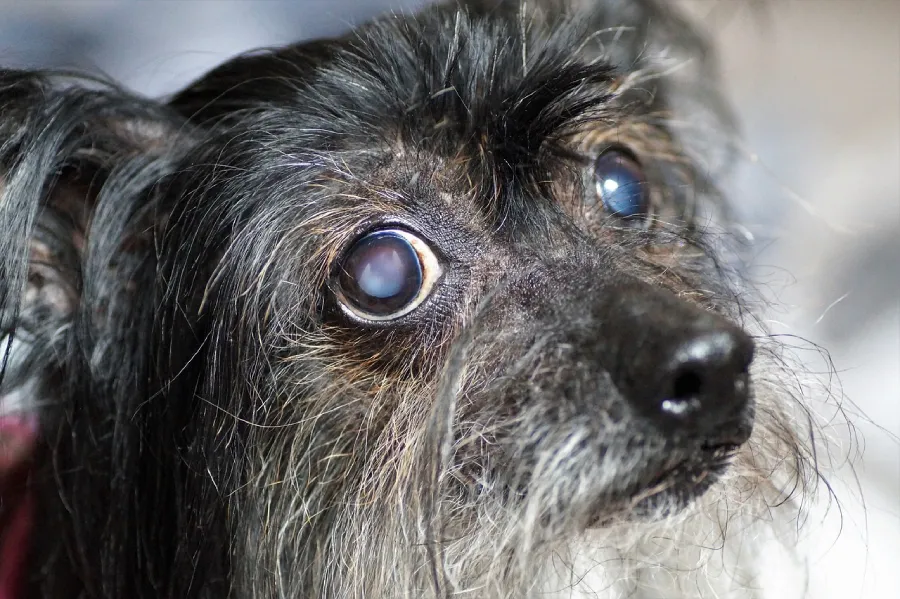
Anne has an adorable little 12 year old Cairn terrier mix named Smudge. Anne looked into Smudge’ eyes every day– and he looked into hers. It is a gaze of mutual devotion and love– especially when Anne tossed a treat for him to catch in mid-air. One day, in her daily treat ritual, she realized that it was the third time in a week that Smudge missed catching the treat. Anne picked up Smudge and gazed into his little face. She had known for a while that both pupils were looking a bit hazy, like all old dog eyes look, but had attributed it to old age. But now the pupil of the right eye looked quite milky, compared with the left eye.
Anne turned on the flashlight on her cell phone and aimed it at Smudge’s eyes to look closer, but the bright light made his pupils constrict and she couldn’t see anything. Ann put Smudge down and tossed more treats–some of which he caught, and some he missed. All the ones he missed had been thrown off to his right. He always saw the flick of her hand as she tossed the treat, but lost the treat as he tried to snatch it out of the air. Ann was dismayed and distraught.
Could this be cataracts? Anne thought about her grandmother, who had cataract surgery performed and loved how much better her vision now was. Anne immediately called her veterinarians’ office and scheduled an appointment, but the soonest Smudge could be seen was in 4 weeks. Anne was very worried. Four weeks would not pass fast enough…
Introduction
A cataract is any opacity (cloudiness) inside the lens, from a tiny white speck all the way up to the entire lens being white. Eyes and cameras both have lenses. Lenses bend and focus light to send it places: in film cameras, light is sent to the film strip; in digital cameras, it is sent to a digital sensor; and in eyes it is sent to the retina.
Advertisement
What is a Cataract?
The lens inside an eye is living tissue. It is made up of protein, much like egg whites. In fact, the lens has the highest concentration of protein in the body (35% in dogs). A good way to think about cataracts is the nature of egg whites, which are also high in protein (10%). When raw eggs are cooked, the clear egg whites turn white because protein is broken down by heat— irreversibly.
Lenses are very similar in that clear lens proteins will turn irreversibly white if the protein breaks down. Therefore, just as egg whites cannot be “unfried” and turn clear again, neither can cataracts be reversed.
In all cases, the lens must be clear in order for light to pass through it. A cataract can be very small (“incipient cataract”) and not interfere with vision.

Incipient cataracts are smaller than the head of a pin, and are often not detectable without special instrumentation (biomicroscopy). They can enlarge over time and interfere with vision.
It can involve more of the lens (“immature cataract”) and cause blurred vision.

Lenses with immature cataracts still have some clear areas through which vision is possible. All immature cataracts are larger than the head of a pin. These cataracts blur or partially block vision. A) One example of an immature cataract; B) Three other examples of immature cataracts.

This eye is still functionally visual, but has areas in which vision is blurry, and areas where vision is blocked.
Eventually, the entire lens can become cloudy (“mature cataract”) and functional vision lost except for light and dark perception.


Assuming that this eye is healthy other than the completely cloudy lens, this eye is blind other than being able to detect light vs dark.
Typical history: Over a 1-7 day period, a diabetic dog can become blind (other than light/dark perception) in both eyes from rapidly developing mature cataracts. Affected dogs should be seen by a veterinary ophthalmologist ASAP.
Rapid cataract development in diabetic dogs is a medical and surgical emergency, as the lenses can swell and damage the eyes by causing severe lens-induced uveitis.


Some mature cataracts (but not all) will transform over time into advanced cataracts (“hypermature cataract”). Advanced cataracts usually are shriveled due to loss of water and proteins over time. This usually causes the lens to shrink and the lens capsule to wrinkle—similar to a grape turning into a raisin.
Hypermature cataracts vary in how cloudy they are. Some are completely cloudy, and others have clear areas that can allow partial recovery of vision if the rest of the eye is functional. But this potential recovery of some vision comes at a cost and is never predictable.

A mature cataract turning into a hypermature cataract is similar to a grape shriveling and becoming a raisin.

Depending on the dog’s age and breed, it can take several months to years for a mature cataract to turn into a hypermature cataract. Because eyes with both mature and hypermature cataracts are at risk for serious complications (particularly uveitis, glaucoma, and/or retinal detachment), it is best to perform cataract surgery before mature and hypermature cataracts form.
A cataract does not need to be “ripe” before a veterinary ophthalmologist should examine the patient and in order for cataract surgery to be formed. In fact, it is best if animals with cataracts be examined by a veterinary ophthalmologist before the cataract becomes mature or hypermature.
Even if surgery is not being considered by the owner, dogs with cataracts should be under the care of a veterinary ophthalmologist.
Advertisement
What is not a cataract?
All geriatric dogs (depending on the breed, but usually beginning at 6 years of age) develop a hardening of the lens nucleus (“nuclear sclerosis”) that causes the lens to have a grayish to bluish gray appearance.


This eye also has some small immature cataracts (enclosed by red dashed arrows). The eye is visual, except that night vision is reduced due to senile retinal degeneration, and vision is a bit blurry in bright sunlight (causing pupil constriction) as the light rays are passing only through the small pupil, and thus only through the nucleus, which is the densest part of the lens. This dog does not need cataract surgery; its functional vision is good.
The grayish-blue haze increases as the dog ages. Nuclear sclerosis is normal and is NOT a cataract, and does not usually interfere with vision.
Nuclear sclerosis also occurs in humans, and the hardening of the lens with age results in reduced near-vision in people; this is why people in their 40’s and older need reading glasses—because their lenses no longer are soft enough to easily change shape to allow for near vision. Another name for this is “presbyopia”, which means “old eye”. Dogs do not have good near-vision to begin with (compared with people), so nuclear sclerosis does not significantly interfere with their near-vision.
How do you tell the difference between nuclear sclerosis and cataract in your dog? The answer is that you really can’t without the proper instrumentation and medical knowledge. Do not presume that just because the eyes of your old dog or cat are cloudy, that cataracts are present!
You can start with having your family veterinarian evaluate your dog’s eyes, but just as in human medicine, it is often difficult for a doctor who is not an ophthalmologist to differentiate between the two conditions.
It is understandably very common for general veterinary practitioners to diagnose that cataracts are present, when in fact the dog simply has nuclear sclerosis. However, veterinary ophthalmologists can tell the difference between nuclear sclerosis and cataract, using specialized equipment and their expertise.
Also keep in mind that dogs can develop BOTH nuclear sclerosis AND cataract—many geriatric dogs do develop cataracts! In fact, most geriatric dogs have age-related incipient cataracts, but these do not affect functional vision.
If your older dog has cloudy eyes but still appears to see well, this does not mean that they don’t have cataracts—dogs can see fairly well if their cataracts are small. Dogs also can adapt well if one eye is blind from cataract and the other is not. Often, they adapt so well that the owner does not realize that the dog cannot see out of one eye!
Dogs can also adapt well—up to a point—if both eyes gradually develop severe cataracts; dogs can develop a “memory map” as to where things are in their familiar environment. Dogs with poor vision do not let their owners know that they have a vision problem until it is severe in both eyes.
Why did my dog develop a Cataract?
Cataracts have many causes in dogs, and sometimes it is not possible to identify the cause in affected patients.
Genetic: Most cataracts in dogs are inherited and can occur at any age. The cataract may develop rapidly over weeks, or slowly over years, and occur in one or both eyes. Different breeds of dogs have different characteristics of cataract development. For example, cataracts in Bichon Frise dogs tend to develop rapidly in early adulthood and usually involve the entire lens in both eyes. Mixed-breed dogs can also develop inherited cataracts.
Diabetes: The second-most common cause of cataracts in dogs is diabetes (diabetes mellitus). Seventy-five percent of diabetic dogs will develop blinding cataracts within the first nine months of being diabetic (see Figures 7 and 8). Often, the cataracts form very shortly after the dog becomes diabetic. Diabetic cataracts develop VERY fast—often overnight—in dogs, and are a medical and surgical emergency.
NOTE: Did you know that if a diabetic dog is supplemented daily with Ocu-GLO™, a high-quality veterinary vision supplement*, BEFORE diabetic cataracts form, this may help prevent blinding diabetic cataracts from forming?
Toxic: The third most common cause of cataracts in dogs is a toxic reaction in the lens—the lens is “sick”, due to some other ocular disease or (much less commonly) due to a drug reaction. These are called “toxic cataracts”. The most common causes of toxic cataracts:
- Retinal degeneration, especially Progressive Retinal Atrophy (PRA)
- Uveitis (intraocular inflammation) (NOTE: “intraocular” means inside the eye) of any cause, including infection or trauma
- Glaucoma (increased intraocular pressure) of any cause
A special type of toxic cataract occurs in dogs in which the lens capsule is ruptured due to trauma. The trauma can be penetrating (such as a cat claw injury or pellet gun injury) or a severe blow to the eye that results in lens capsular rupture.
The lens contents leak out through the hole in the capsule and cause both cataract and a severe immune-mediated uveitis. It is not always apparent that the lens capsule has ruptured; often, by the time this is diagnosed it is too late to save the eye and the eye needs to be removed. Thus, it is prudent to seek immediate medical attention for ANY injury to your dog’s eye.
If the lens swells, lens capsules can stretch and split open like a ripe tomato skin (intumescent lens/cataract). This most commonly occurs when mature cataracts rapidly form—especially in diabetic dogs and in certain breeds of dogs with inherited cataracts.
Swelling and eventual rupture of the lens capsule is an emergency that requires cataract surgery ASAP; dogs suspected to have this condition should be referred ASAP to veterinary ophthalmologists by general veterinary practitioners; it is very difficult for general practitioners to diagnose this condition, due to the required ophthalmic instrumentation and specialized knowledge.
Nutritional: Cataracts can also rarely develop due to nutritional deficiencies in dogs, such as puppies on an artificial milk-replacer diet. These are called nutritional cataracts, and they often will improve as the puppy matures.
Aging: Dogs also can develop cataracts with age (often after 8 years of life). However, unlike in humans, age-related cataracts (“senile cataracts”) in dogs are usually small and do not significantly interfere with vision.
There are many other potential causes of cataracts in dogs, such as birth defects, infection, radiation (usually from prolonged radiation therapy for cancer of the head), etc. but discussion of these causes is beyond the scope of this overview article.
Treatment of cataracts, including cataract surgery, will be covered in companion articles in PetHealthHarbour.com.
What is the rest of Smudge’s story? Smudge’s veterinarian, Dr. Jane Doe, diagnosed cataracts in both eyes, but cautioned Anne that Smudge needed to see a veterinary ophthalmologist in order to best diagnose Smudge’s condition and determine treatment options.
Anne was worried about the cost of cataract surgery and was afraid she could not afford it; Dr. Doe encouraged her to have an ophthalmologist examine Smudge, so that Anne could make the best informed decision for her best friend.
So Anne called to make an appointment for Smudge with the veterinary ophthalmologist recommended by Dr. Doe, but Smudge could not be seen right away. He was finally seen 2 months later, and here is a summary of the ophthalmologist’s report to Anne and to Dr. Doe:
Advertisement
Conditions Diagnosed
- Immature cataract in the right eye
- Several incipient cataracts in both eyes (age-related)
- Nuclear sclerosis in both eyes (normal)
- Senile retinal degeneration in both eyes (normal for a 12 year old dog)
Assessment of Vision
- Reduced night vision in both eyes (due to senile retinal degeneration)
- Right eye: 75% vision in normal light. Vision reduced further in very bright light because the densest part of the immature cataract is in the center of Smudge’s lens; in bright light the pupil constricts and becomes very small, not allowing vision through the central cloudy lens
- Left eye: Normal vision in normal light
Advertisement
Recommendations
- Cataract surgery is an elective surgery; while it is possible to perform this for the right eye, it is not recommended at this time, as Smudge is still quite functionally visual.
- Keep his facial hair clipped closely so that it does not interfere with the vision he still has. Ann should not see any hair obstructing her view of Smudge’s eyes, from her side, top, or front view of Smudge’s eyes. If hair obstructs her view, then it must be clipped closely. Either have Smudge’s groomer cut the hair, or Anne can clip it using blunt-tipped grooming scissors.
- No medical treatment is recommended at this time, but if the immature cataract progresses, Smudge may need to be placed on a lifetime anti-inflammatory eye drop in the right eye, to help prevent/control the development of lens-induced uveitis.
- Daily lifetime administration of a vision supplement (Ocu-GLO™) to help support lens health to reduce the risk of further cataract formation, and to help support the retinal cells (rods) important for night vision that are damaged due to aging.
- Have Anne provide lighting in her home and yard, that Smudge can rely on at night and whenever lighting levels are low, such as poorly lighted stairs. A good idea is to place night lights strategically around your home, that will automatically turn on in low light.
- Have Anne provide sensory clues (such as a non-slip mat or runners) to help Smudge know where he is in dim light, especially the top and bottom of stairways and other steps. Elderly dogs can fall down stairs and seriously injure themselves. Plus being a small dog, Smudge could easily miss a step and fall.
Another type of sensory night light can be rotated to direct the light to specific sites. - Smudge is 12 years old. He might be arthritic and painful at times (but might be hiding it). He will likely lose some hearing (but might be faking it), and/or might develop senile dementia (canine cognitive dysfunction). Pain, reduced hearing, and reduced vision can all affect brain function—and reduced brain function can affect hearing and vision! The antioxidants in the vision supplement also help support brain health. The ophthalmologist suggested that Smudge’s general practitioner evaluate Smudge for arthritis and treat for this condition if in doubt—it might help Smudge be sharper and also best use the vision he still has.
- Continue “challenging” Smudge’s vision with treats, toys, etc. and log his responses. Look at his eyes daily, and monitor for any changes. For toys, use blue toys as dogs see mostly in blue and yellow, but blue is best.
- Reexamination in 6 months, but Anne was to contact the office if she had any concerns.
Anne was very relieved that her little Smudge did not need surgery at this time, and that there were some actions she could take to help him live his best life!
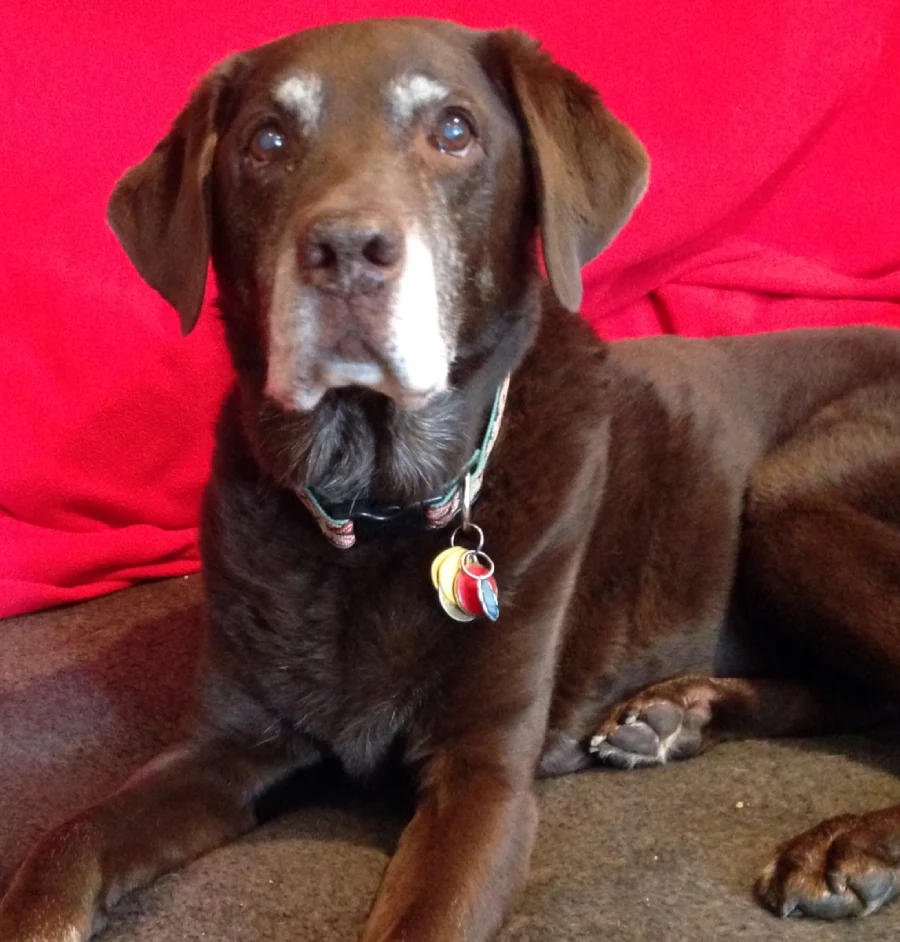
1. Freeze-dried beef or chicken liver:
2. Lean Treats® (low fat chicken treats):
3. Charlee Bear® Original Crunch Treats (low-calorie, for dogs that like crunchy treats. Treats keep their shape in your pocket). Beef liver variety:
4. Diabetic dog treats (Old Dog Cookie Company Diabetic Tiny Treats):

By Terri L. McCalla BSc, DVM, MS, Diplomate ACVO
Dr. Terri McCalla Dr. McCalla received a BS in Animal Health Science from the University of Arizona, followed by her DVM degrees from both Oregon and Washington State Universities in 1984. She completed a 3 year residency in Comparative Ophthalmology from the University of Missouri and became board-certified in the American College of Veterinary Ophthalmologists (ACVO) in 1989.