 Pet News

Summary
Keeping the fur around your dog’s eyes clean helps reduce eyelid skin and ocular surface inflammation. To clean discharge, use gauze squares or folded tissues to catch and blot fluid. For dried discharge stuck to skin and hair, use a special gel to soften crusts before gently combing them out.
Wipe the skin around the eyes with soaked gauze, moving from the inside to the outside corners. For cleaning the eye surface, create a pocket in the lower lid and gently apply eye wash drops. Trim any obstructive hair to improve hygiene and ensure clear vision.
Introduction
Part I of Cleaning Your Dog’s Eyes details the preparation and the gear for cleaning your dog’s eyelids and eyes. Please see Part I to access links to all products and supplies to clean your dog’s eyes. Just as you need to pay special attention to the process if you were cleaning your own eyes, the same is true for taking care of your dog’s eyes.
Advertisement
Preparing for the Cleaning
Proper restraint of your dog is the first step in this process. Depending on your dog’s size and temperament, you might need a second person to assist you.
Position your dog at a level that’s comfortable for you both, such as on the floor, on a table, or sitting across from you. Always prioritize both you and your dog’s comfort and safety; you must be able to sustain the position, especially while keeping a squirming dog still.
Cleaning your dog’s eyes while you are bent over with a painful back is not OK. If necessary, consider giving your dog a mild sedative, especially if their eyes are painful.
A very effective restraint position is to kneel on the floor and place your dog between your knees, so that you are both facing the same direction.
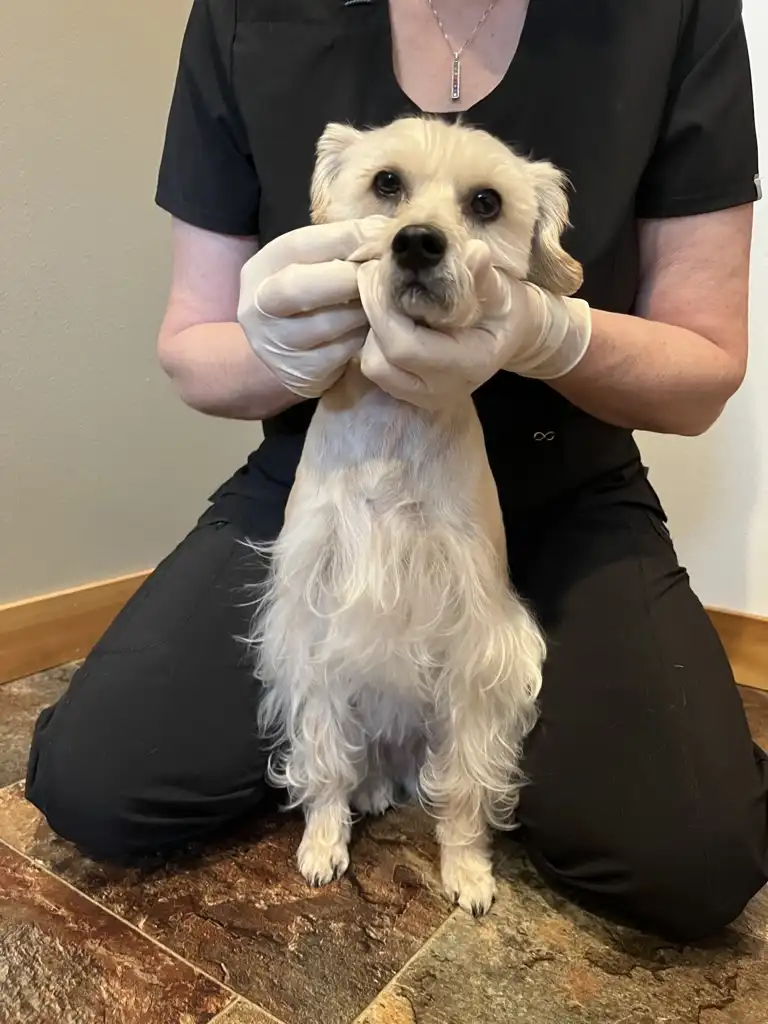
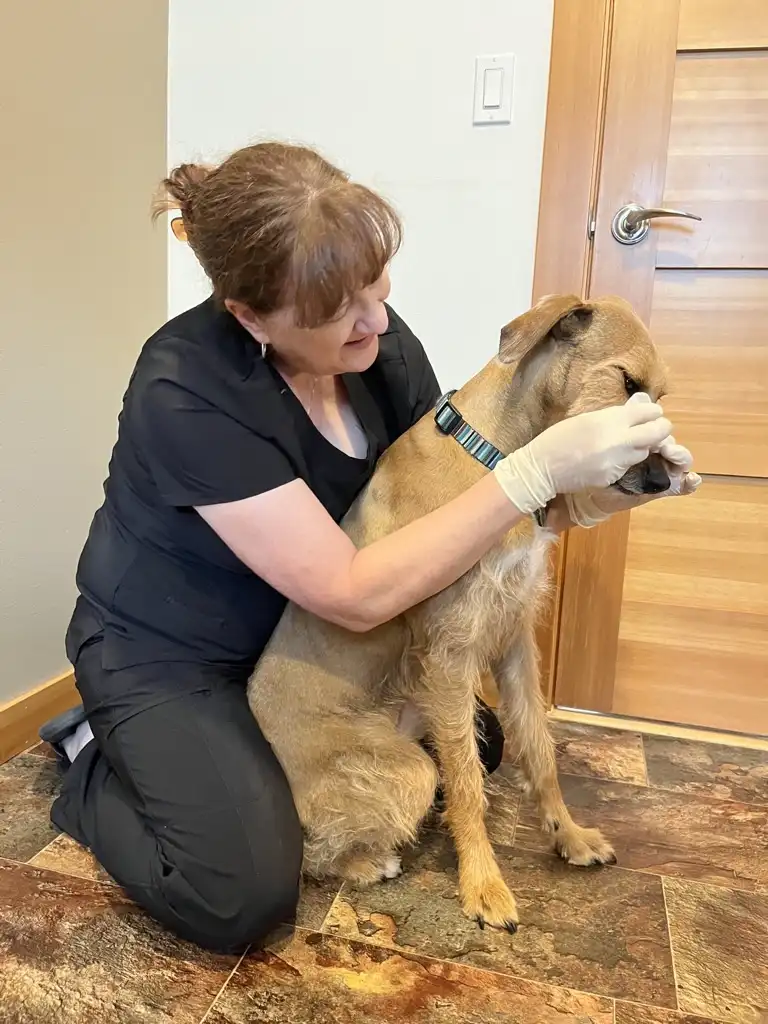
You may wish to wrap him in a towel to prevent him from struggling and pawing.


With one hand, support his chin (or hold his muzzle, if he has a long enough muzzle to do so). Tilt his head up and use your other hand to clean his eyes. Do not scruff him. Place a muzzle on him beforehand, if necessary.
The Cleaning Procedure
There are two goals, but sometimes just one of them is needed:
- Cleaning the eyelids and nearby facial skin, if discharge is present.
- Cleaning the surface of the eye if discharge and/or debris is present.
Necessary steps for both goals:
- Plan ahead. (See Part I for more details). If indicated, give your pet a sedative beforehand. If your pet was prescribed pain medication, make sure it has been given beforehand and is in “full effect”, so that your pet is as comfortable as possible during the cleaning.
- Never place your fingers closer to the eye than the bony orbital rim (the rim of the eye socket), as it is very important to not apply pressure to the eye. This is especially true if the eye is painful, and it is critical if a deep corneal ulcer is present as pressure could rupture the eye. You can feel the boundaries of the orbital rim by gently moving your fingers over your dog’s face near the eyes. If one eye is painful, then explore your dog’s face around the other eye, to help you envision the boundaries of the eye socket.
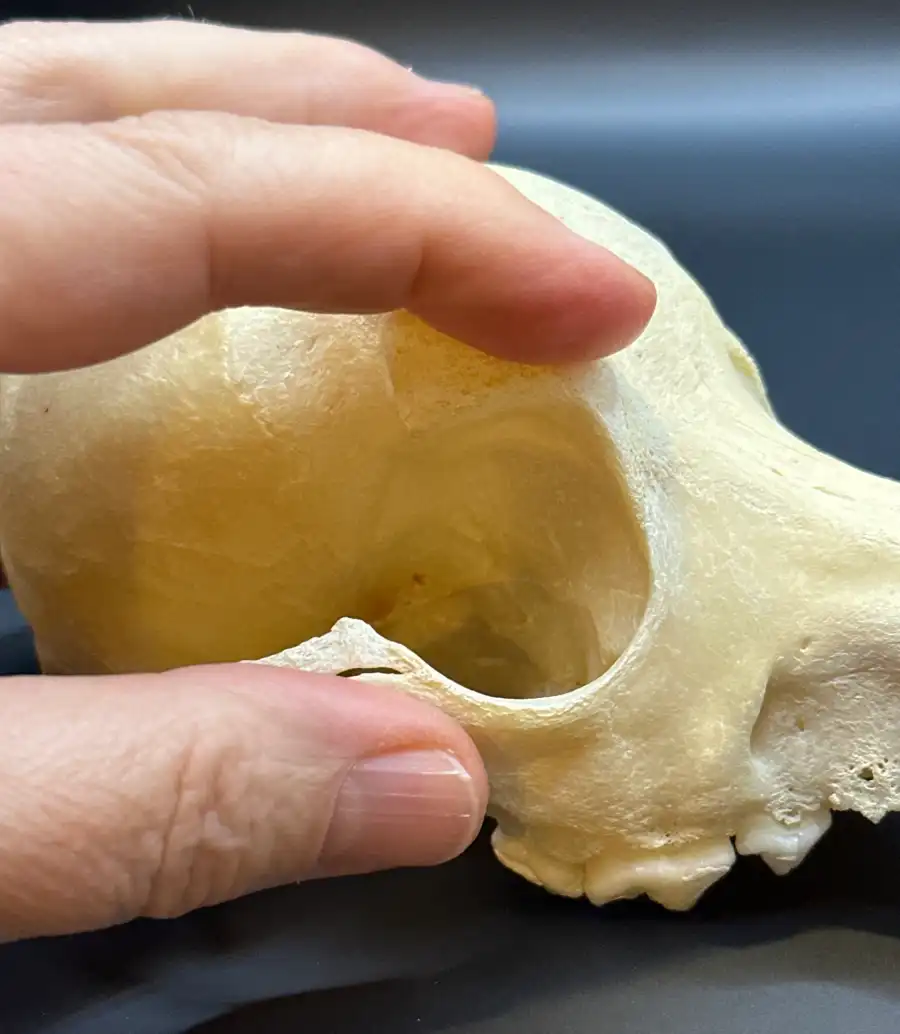
- Restrain your dog and tilt her head upwards.
- Place and hold a folded facial tissue or a gauze square on the inner corner of the eyelids to “catch” and blot irrigating fluid and discharge. Many dogs do not like the sensation of fluid dripping down their face.
- If the lids are crusted with discharge and there is also discharge on the surface of the eye, it is usually best to first clean the lids because they take the longest to do. Plus cleaning the eye itself is more likely to be uncomfortable for the dog, so it is best to do the most uncomfortable task last.
- You might need to give your dog breaks during the cleaning. The worst case scenario is that you have four eyelids to clean and two eyes, and the dog is painful– that is a lot to handle!
Once your dog is comfortably and firmly restrained, you can start the cleaning process. If your dog is strong-willed and does not accept regular cleanings but needs them for their lifetime, consider working with an animal behavior therapist to help your dog learn to accept having their face, eyes, and eyelids cleaned and facial hair trimmed. Better yet, start when your dog is a puppy, so that they know from the very beginning that eye cleaning is part of their life.
Cleaning the Eyelids and Nearby Facial Skin
- Treats before, during, and after!
- No animal will be happy if you try to simply pull dried discharge off that is stuck to eyelid hair. It hurts—especially if the skin of the lid is inflamed and painful, and/or if the eye itself is painful.
- If there are dried crusts stuck to the hair and/or skin around your dog’s eyes, the first step is to soften them. Apply I-Lid ‘n Lash® Vet gel to these areas, “painting” it on with your clean finger, and then let your dog relax for about 10 minutes (don’t let them wipe the gel off their face) to allow the gel to soften the crusts and make them easier to remove. If the gel contacts the eye, it is OK.
- If your dog has long hair with matted dried crusts, in severe cases the eyelids are literally glued together and you cannot even see the eye until the lids are cleaned and the hair is trimmed. Removal of crusts for these dogs will require careful clipping and removal of the hair—possibly by your veterinarian under sedation or anesthesia. Underneath the crusts, the skin is often irritated and inflamed and it hurts to pull the crusts off. So do not pull ! Rather, the goal is to soften them to the point of being able to gently comb them out of the hair and/or cut them out, with no pulling or yanking.
- After the crusts have turned moist and softened, take your plastic flea comb and gently comb out the softened discharge from the hair (if there is lots of discharge, use multiple clean combs so that you don’t need to pause and wipe discharge off of one comb before proceeding). If the dog struggles, the curved ends of plastic flea combs are less likely to injure the eye than metal combs. You might need to cut some hair mats off with the blunt scissors before combing out the softened material. It’s essential to be patient and gentle during this process to avoid causing discomfort or harm to your dog. It is very important to make this experience as positive as possible for your dog. When in doubt, pause and give her a treat.
- If the discharge is particularly stubborn, you may need to reapply the gel and wait another 5-10 minutes before trying again. Remember, you want to make this a positive experience for your dog! You must be patient.
- After combing out the discharge, wipe and clean the lid skin with gauze squares soaked in the eye rinse (do NOT squirt the eye rinse onto the lids). It helps to have the gauze squares presoaked in the eye rinse (not dripping wet) and laid out on a clean small plate, ready to use. For nervous dogs, it helps to pre-warm the eye rinse fluid, such as placing the bottle in a cup of warm water to take the chill off of the fluid.
- Gauze squares work much better than facial tissues, as the woven fabric of the gauze provides gentle friction to help remove debris and does not fall apart when wet. Do NOT use cotton balls—they shed tiny fibers onto the surface of the eye. Do NOT use swabs, as you could injure the eye if the dog moves suddenly. Be sure to wipe from the inside corner of the eye outward, using at least one new gauze square per eyelid to avoid spreading any potential infection. After wiping the lids, gently dry them using dry gauze squares or facial tissue.
- As a general rule, when wiping the eyelids it is important to not place pressure on the eyeball itself. Your fingers should rest on eyelid skin that overlies the bony orbital rim, and not any closer to the edge of the lid. By resting your fingers on the orbital rim, you are never pushing on the eyeball, this is also more comfortable for the dog, and if the eye has a deep corneal ulcer you will not potentially apply pressure and rupture the eye (yes, this can happen, especially in flat-faced dogs with “bug-eyes”).
Advertisement
Nasal Folds: Nasal folds in brachycephalic dogs such as French Bulldogs need to be clean and dry, especially if excessive discharge and/or tearing occurs. If nasal folds are moist, bacterial and yeast infections commonly occur and there is an unpleasant facial odor. Daily cleaning of the folds (avoiding contact with the eyes) is important, avoiding swabs as they could poke the eye. If the wipe is too large to apply, cut it into smaller pieces for easy application.
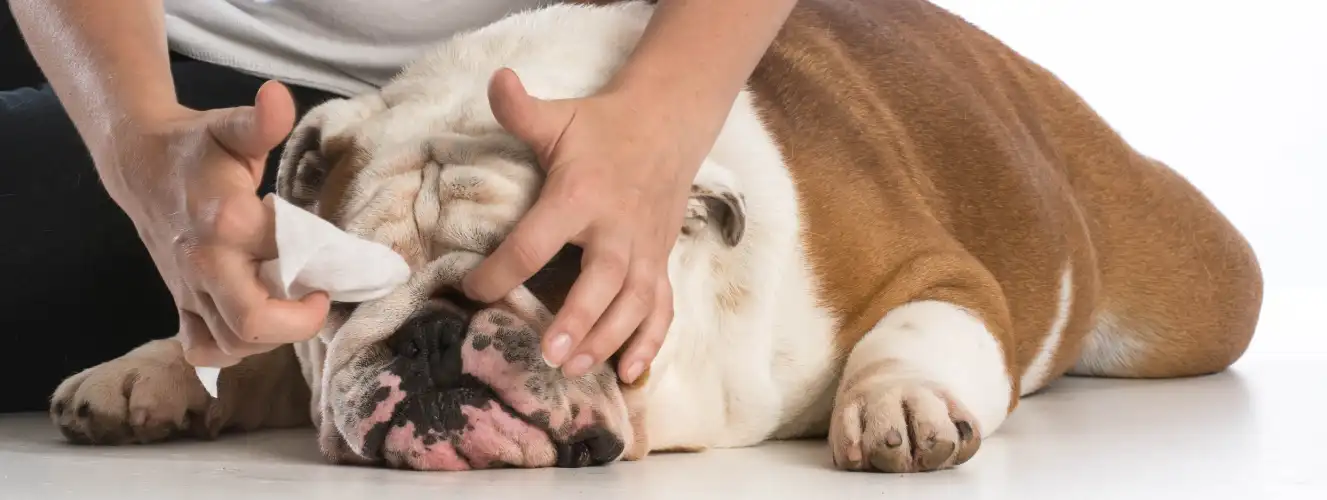
If applied daily, I-Lid ‘n Lash® Vet gel (both the pump bottle and the wipes) work well to clean and keep nasal fold skin healthy. After applying the gel, do not rinse it off. Let it “sit” for 10 minutes before blotting dry the deep recesses of the nasal fold with gauze squares or facial tissue.
However, if nasal fold skin is inflamed and tender, the best product is a wipe containing chlorhexidine, ketoconazole, and aloe. After applying the wipe, dry the folds using tissues or gauze squares.
Tear Burn: This is a special type of eye discharge most common in dogs with long facial hair if the hair is not closely clipped every 3 weeks or so, and usually both eyes are affected. Dried discharge can accumulate on the skin at the inside corners of the eye, and become trapped in hair. The skin under this matted hair becomes irritated, with open sores forming that are hidden under the mats.
The condition can be very painful, so many dogs resist cleaning and removal of the mats and the mats can become quite severe, creating a vicious cycle. These patients usually need to be treated under sedation by a veterinarian, and often prescription medication is needed to apply to the skin wounds, in addition to dispensing an E collar to prevent rubbing and self-trauma.
Additionally, the cause of the discharge must be determined and addressed (often, the cause is excessive facial hair, and/or dry eye). Once the skin has healed and the cause addressed, then regular cleaning of the eyelids (often daily) is needed, in addition to clipping of facial hair every 3 weeks or so to help prevent recurrence.
Tear Staining: Many dogs simply have chronic tear staining, which can have many causes. It is often a cosmetic issue and not a medical concern (unless tear burn or nasal fold dermatitis is present). For purposes of this article, only cleaning the tear stains will be addressed.
Preventative maintenance is key, with the goal of preventing the formation of newly stained fur. This is done by daily cleaning of the stained fur with I-Lid ‘n Lash® Vet gel. After applying the gel, gently rub it into the stained fur in a circular motion and let it dry (do not rinse it off). The gel works to prevent tear stains while hydrating the skin.
It is a soothing gel, because it contains hyaluronan (also known as sodium hyaluronate or hyaluronic acid). The gel helps you easily clean the lids and nasal folds while causing the least amount of discomfort to your dog. It is soothing and also helps resolve nasal fold odor.
Advertisement
Cleaning the Surface of the Eye
Sometimes the eye cannot be cleaned until tangled, matted hair covering the eyes is cut away. Do not try to salvage this hair; if it is contacting the eye, it means that the hair is too long and MUST be cut!
- Place a gauze square or folded facial tissue on the inside corner of the eye.
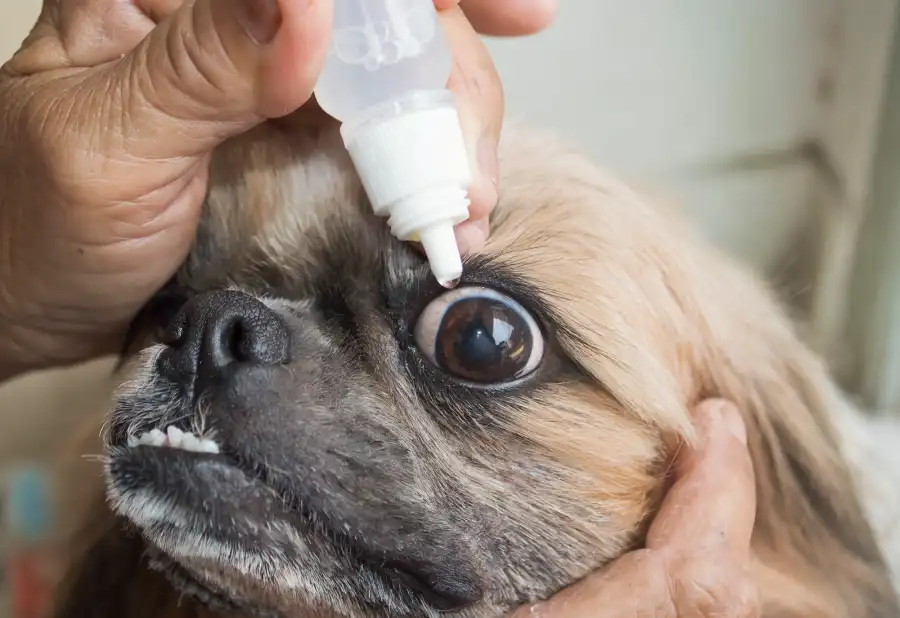
- Tilt your dog’s head up and gently roll out the lower lid (placing your fingers no closer to the eye than the bony orbital rim) to create a little pocket. Take the eye rinse and drip (do NOT squirt a stream of fluid!) 2-4 drops into the pocket.
- Alternatively (especially in brachycephalic dogs) you can lift the upper lid and apply the drops to the 11:00 to 1:00 position above the cornea, where pink conjunctiva overlies white sclera.

- “Dive bomb” the drops from a short distance and do not let the tip of the bottle touch the eye. Aim the drops to land on the less-sensitive conjunctiva, and NOT on the cornea.
- Then catch and blot the drops as they flow onto the face, using the gauze square or facial tissue you have already placed on the inside corner of the eye and lower eyelid.
- If necessary, gently open and close the lids, to help massage discharge loose that is trapped under the lids, then apply 2-4 more drops into the pocket to “float” the discharge. Catch and blot this liquid with the gauze or tissue.
- Repeat as needed. If your dog has dry eyes, the discharge is often very sticky and “ropey”. This means that when you add eye rinse to the surface of the eye, the discharge absorbs the water and ‘plumps up’ so there is more of it to rinse out as the cleaning progresses. Also, in dry eyes there is often a lot of discharge trapped under the lids, so when fluid is added to it, the discharge plumps up and just keeps emerging from under the lids (like a lot of clowns emerging from a clown car!) as you gently open and close the lids to “work out” the discharge. It is tempting to use a swab in this case, but the risk is too great that you could injure the eye. Just as you should not insert a swab up into your ear canal, you should not insert a swab under the lids of your dog.
- The last step is to trim all hair that may be obstructing your dog’s vision or that could potentially get into their eyes. This includes long hair on the ears, and any long “sideburns” of hair. Using your blunt-tipped scissors, carefully trim these hairs, taking care not to get too close to your dog’s eyes. Alternatively, you can have your groomer do this task, but in urgent cases with painful eyes, often an appointment with the groomer can’t occur quickly enough for what your pet needs now.
Advertisement
And when you are finished, give yourself and your dog each a good treat for a job well done!

By Terri L. McCalla BSc, DVM, MS, Diplomate ACVO
Dr. Terri McCalla Dr. McCalla received a BS in Animal Health Science from the University of Arizona, followed by her DVM degrees from both Oregon and Washington State Universities in 1984. She completed a 3 year residency in Comparative Ophthalmology from the University of Missouri and became board-certified in the American College of Veterinary Ophthalmologists (ACVO) in 1989.