 Pet News


Summary
Cats’ unique physiology significantly heightens their risk of toxicity from human eye medications. Their distinct metabolic processes, lacking certain liver enzymes, make them vulnerable to adverse effects. Anatomical differences, like the presence of a third eyelid and variations in eye size and shape, can lead to increased drug concentrations in ocular tissues.
The sensitivity of cat eyes, coupled with their smaller body size, means that human-safe dosages can be harmful, and typical feline grooming behaviors can result in the ingestion of applied medications.
Additionally, cats’ higher body temperature and specific tear production and drainage mechanisms can alter the impact of medications. Risks of severe reactions to certain drugs, such as polymyxin B, apraclonidine, brimonidine, beta-blockers, and atropine, emphasize the need for careful veterinary oversight and the dangers of HEMs use in cats without veterinary oversight.
Introduction
Part 1 of this two-part article series introduced the concept that using human eye medications (HEMs) without veterinary guidance is dangerous and might even be potentially fatal in cats. Consultation with a veterinarian is critical for safe and effective treatment, and the secure storage of HEMs is essential to avoid accidental harm. Despite limited cat-specific options, veterinary oversight ensures appropriate care.
Part 2 of this article series explains the differences between cats and humans that can lead to HEMs making cats sick, and also lists specific HEMs that can be harmful to our feline friends.

How do differences between cats and humans increase the risk of toxicity from HEMs in cats?
Cats can have an increased risk of toxicity from HEMs due to several physiological, anatomical, and metabolic differences between these species and humans. Here are some key differences that contribute to this increased risk:
-
Metabolic differences: Cats metabolize some drugs differently than both humans and dogs do. Cats lack certain liver enzymes that are essential for metabolizing many medications, making cats more susceptible to toxicity.
-
Anatomical variations: The structure of the eyes in cats differs from humans in terms of size, shape, and the presence of certain anatomical features. This can affect how medications are absorbed and distributed within the eye, potentially leading to an increased concentration of the drug in eye tissues.
-
Sensitivity: Cat eyes are more sensitive to certain medications due to differences in pH levels and tear production. These distinctions are important when considering treatment options.
-
Size and weight differences: The uniformly smaller size and body weight of cats compared to humans mean that a dose of medication that is safe for a human could be excessive for a smaller animal that weighs less than 20 lbs—often much less. Even small amounts of certain drugs can be toxic to cats. As described in Part 1 of this article series, much more of an eye medication is retained and absorbed on the surface of a cat eye than on a human eye.
-
Grooming: Cats groom their faces by rubbing a paw over their face and then licking the paw. Likewise, other cats (and/or dogs) in the household might groom and lick the faces of their buddies. If an eye medication (drop or ointment) is applied to the eye and some of the medication ends up on the eyelids or dribbles down the face, it could be licked and ingested, potentially causing illness. Additionally, cats can lick their own noses, increasing the amount of drug in an eye drop that is ingested.
-
Higher body temperature: Cats have higher normal body temperatures than humans. This can affect the tissue absorption of eye medications.
-
The third eyelid: Unlike humans, cats have a third eyelid. This structure protects the eyes by sliding up over the surface to block the eye from injuries. It also acts as a “squeegee” to sweep debris off of the cornea. Topical eye medications are absorbed by the cornea and the conjunctiva. The third eyelid is covered by conjunctiva (front and back). Since cats have more conjunctival surface area than humans do, more drug can be absorbed by cats.
-
Differences in tears: The pH and composition of tears can vary between species, which may affect the solubility and absorption of ophthalmic drugs. Differences in pH is one of the primary reasons for an eye drop to sting. Any eye discomfort from an eye drop tends to trigger big reactions in cats!
-
Differences in tear production and drainage: The tear film and its production, as well as the drainage system in cats, differ from those in humans. This can influence the duration and intensity of exposure to a drug administered as eye drops, potentially leading to increased toxicity.

-
Brachycephalic cats, and cats with painful eyes often tear excessively, often resulting in epiphora due to tear overflow. Tears normally drain out the tear duct (nasolacrimal duct) into the nasal cavity near the nostril (which is why we need to blow our noses when we tear excessively).
After application to the eye, eye medications mix with tears and then either drain out the tear duct or spill over onto the surface of the eyelids/face.
Brachycephalic cats such as Persians often have epiphora due to poor nasolacrimal duct drainage. Cats with slow/poor tear drainage through their tear ducts can have more of a topically applied drug absorbed into their bodies through the lining of the duct.
Overflow of tears onto the face (epiphora) increases skin exposure to and absorption of a topical drug. Licking and grooming the face can result in ingestion of medication.
-
Some cats have a secondary tear drainage pathway through the roof of the mouth, just behind the upper incisors. These cats can ingest eye medications that drain into the mouth.
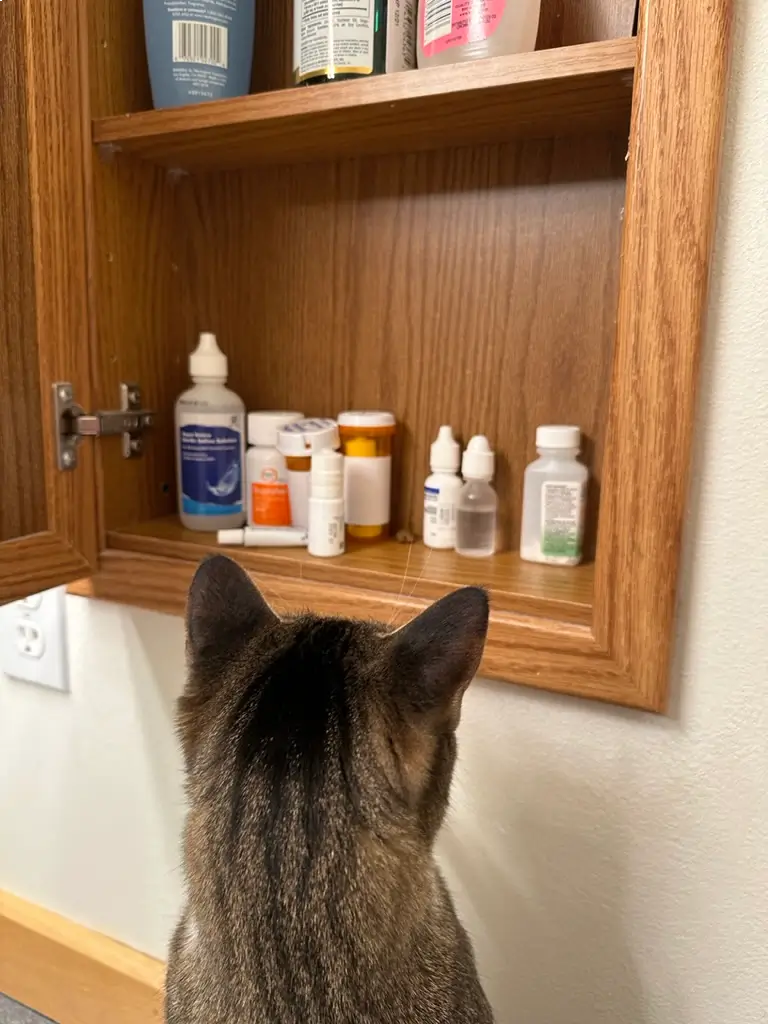
Risks of Using Human Eye Drops on Pets
-
Chemical Composition: Many human eye drops contain chemicals and preservatives that can be harmful to pets. For example, zinc sulfate, found in some human eye products, can be very irritating to cat eyes.
-
Dosage Differences: The concentration of active ingredients in human eye drops is often not suited for the smaller bodies of cats, potentially leading to overdosing.
-
Allergic Reactions: Cats can have allergic reactions to components in human eye drops, which can exacerbate eye issues rather than alleviate them.
-
Specific Eye Conditions: Certain eye conditions in cats require specific treatments that human eye drops cannot provide. Using the wrong type of treatment can delay proper care and worsen the condition.
What are the “Red Alert” Human Eye Medications That Are the Most Toxic?
One thing to keep in mind is that your cat might have an underlying condition that you don’t know about, such as glaucoma or heart disease, which could make your pet more sensitive to the harmful side effects of some of these medications.

-
Apraclonidine (Iopidine®) and brimonidine (Alphagan®): These are glaucoma drugs that lower the intraocular pressure (IOP) by decreasing the amount of aqueous humor produced in the eye. They are in a class of drugs called alpha-2-adrenergic agonists and can be highly toxic due to the unique physiology of cats.
-
Severe vomiting usually occurs in cats.
-
Cardiovascular Effects: These medications can cause bradycardia (slowed heart rate) and hypotension (low blood pressure) in cats. These effects are due to their action on alpha-2 adrenergic receptors, which regulate cardiovascular functions. In severe cases, this can lead to shock and cardiovascular collapse.
-
Central Nervous System Depression: These drugs can cause significant central nervous system depression in cats. Alpha-2 adrenergic agonists work by reducing the release of norepinephrine, a neurotransmitter, which leads to decreased sympathetic outflow. In cats, this can result in severe sedation, lethargy, or even coma.
-
Respiratory Depression: These medications can depress the respiratory system in cats, leading to reduced breathing rate and depth. Severe respiratory depression can be life-threatening.
-
Hypothermia: Reduced body temperature, or hypothermia, is another potential effect in cats.
-
-
Polymyxin B: This is a very commonly prescribed topical antibiotic, and is almost always combined with one or two other antibiotics and sometimes a steroid. There are both human and veterinary ophthalmic products that contain polymyxin B. One common combination is neomycin, bacitracin, and polymyxin B (“triple antibiotic”, “bnp”, “nbp”). Another is oxytetracyline and polymyxin B (Terramycin®). A third is neomycin, polymyxin B, and dexamethasone (“neopolydex”).
Just as some children with peanut allergies can have fatal reactions to this food, so can cats have life-threatening reactions to this drug.
Polymyxin B applied to the eye can cause a quite rare but very real and often fatal anaphylactic reaction in cats.
How rare is this reaction? Very! A retrospective study searched for affected cats over a 17 year period (1993-2010), with a query being sent to over 40,000 veterinarians. Only 922 doctors replied, with 41 of them reporting a total of 45 affected cats. In addition to these 45 cats, 16 cats had been reported to the FDA, for a total of 61 cats.1
-
All cats reacted within 4 hours after application of eye medication, and 56% of the cats reacted within 10 minutes.
-
Clinical signs always included at least two of the following body systems.
- Respiratory (open-mouthed breathing, rapid breathing)
- Ocular (reddening and swelling of the conjunctiva)
- Central nervous system (depression/stupor)
- Gastrointestinal (vomiting/drooling, diarrhea)
- Cardiovascular (low blood pressure, irregular heart rate)
- Skin (swelling = angioedema)
-
Most cats were healthy prior to the drug reaction.
-
Some cats had been treated previously with the same medication, and either did not react or had mild reactions.
-
11 cats died.
-
While the risk is very low, affected cats are likely underreported. Many doctors and pet owners might not realize the cause and effect: i.e., that applying any medication to a cat’s eye could cause any adverse clinical signs affecting the body, other than ocular issues.
Does this mean that cat eyes should never be treated with polymyxin B? No. The risk is extremely low that your cat would react to this drug. But the risk is there. If a bacterial infection is present on the surface of the eye and polymyxin B is the best choice for treatment, it could be used with minimal caution. But it is likely that there are other topical antibiotics that would work just as well.
If your cat was prescribed ophthalmic polymyxin B, as an informed pet parent you might want to ask your veterinarian why it is being prescribed and if there is another medication that would work just as well that does not contain polymyxin B.
-
- Timolol and other beta-blocker eye medications: These are used to treat glaucoma. Topical administration can affect the heart and lungs (also in some humans), and commonly causes bradycardia and low blood pressure. Unlike in humans and dogs, timolol will also cause the pupil to constrict (this is to be expected).
-
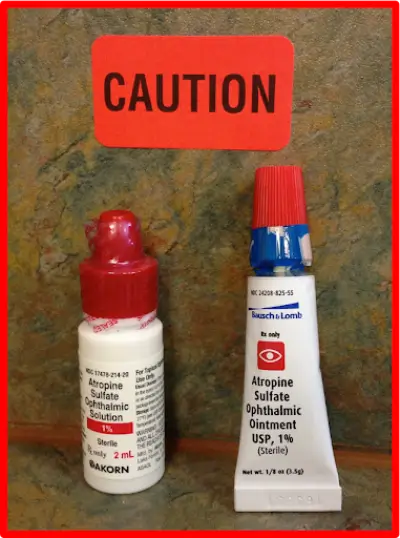
Atropine: Atropine is very bitter-tasting, and if applied to cat eyes in drop form, it will quickly pass through the tear duct to the nostril and be tasted. Cats will drool and foam at the mouth (sometimes mistaken as a seizure by the pet parent). Therefore, atropine ointment is favored for cats because it does not cause as severe a reaction as drops.
Topical atropine can be absorbed by the body and cause side effects, especially in cats. These include a fast heart rate (tachycardia), central nervous system excitement, hyperthermia, slowing of the GI tract, excessive motor activity, and even coma.
- If a cat already has glaucoma, this medication can make the glaucoma worse and could lead to permanent loss of vision.
If you believe that your cat is having a serious reaction to an ophthalmic medication (vomiting, difficulty breathing, depression, severe squinting), restrain your cat and flush the eye and around the eye for at least 30 seconds (including under the eyelids if possible), then seek immediate veterinary care.
Remember to bring with you ALL of your cat’s medications, supplements, and any new product you have recently applied or fed to your cat (think: over-the-counter flea control, or new kind of cat treat, etc.) to show the veterinary staff.
It is good to have the following on hand for emergency use:
Advertisement
The Rest of the Story
Sheri called the veterinary emergency clinic and a veterinary technician named Luis answered the phone. She explained that she had treated her cat with her own glaucoma eye drop called Iopidine®, and now it was vomiting repeatedly and her other cat was also vomiting after presumably licking the other cat’s face.
Luis asked her to spell the name of the eye drop she had applied to PD’s left eye, and then put her on a brief hold. When Luis came back on the line, he advised Sheri to rinse PD’s left eye with preservative free sterile saline eye rinse and then wipe the face, and bring both cats in to the emergency clinic plus the eye drop bottle and a full list of both cats’ medications ASAP.
Sheri told Luis that she didn’t have any eye rinse. Luis advised her to take a small cloth and soak it with water (slightly warmed), and then wrap PD snugly in a towel and squeeze the cloth to drip the water into his left eye for one minute, then bring both cats to the emergency clinic. Sheri told Luis that she could not physically do this alone, as PD was a handful for her in spite of being 14 years old, so she would bring both cats to the clinic ASAP.
The drive to the hospital was horrible, as both cats in their pet carriers continued to vomit. Upon arrival, Luis took both cats to the treatment room while Sheri filled out the paperwork authorizing treatment. She was told that the doctor and staff were taking care of a hit-by-car patient in critical condition, and would examine and treat her cats as soon as possible.
In the meantime, PD would have his left eye irrigated and his face cleaned and dried, and both cats would have their vital signs taken. Luis came back out to the reception area 15 minutes later and told Sheri that both cats had low heart rate and blood pressure readings as a result of exposure to the Iopidine®, so they would both be given an injectable drug to help counteract these side effects, plus an anti-emetic medication (to reduce vomiting) and subcutaneous fluids.
Two hours later, after her pet carriers were hosed out and cleaned, Sheri and her cats were on their way home. Sheri was very grateful. In spite of this awful day, her cats were OK, she was OK, and the sympathetic veterinarian had given her some suggestions on how to purchase the dorzolamide eye medication for PD at a much lower cost.
Luis had also told her how she could restrain PD by herself in the future, by purchasing a special fleece “cat wrap” exactly like what the emergency clinic used. Sheri was impressed with the device! It would make treatment of both cats so much easier. And as the wonderful Luis helped her out to her car with the two cat carriers, he told her that his brother had an appliance repair service, and could take a look at her broken washing machine next week!
Conclusion
If your cat has something wrong with its eye and you have some HEMs in your medicine cabinet, do NOT be tempted to treat your pet with this medication! It would be like giving any random pills you find in your medicine cabinet to your sick cat. While it may be tempting to use HEMs on cats without veterinary guidance, it’s generally unsafe and can lead to serious complications. Cats have specific needs when it comes to eye care, and what works for humans may not be suitable for cats.
While the urge to use human eye drops on cats as a quick solution is understandable, it’s fraught with risks and potential complications. The anatomic and physiologic differences between humans and cats necessitate consulting with a veterinarian or veterinary ophthalmologist for accurate diagnosis and treatment.
Regular check-ups can preemptively address potential eye issues, ensuring early intervention and reducing the likelihood of emergency situations where you might be tempted to search through your medicine cabinet for a suitable eye medication.
Always consult a veterinarian for the correct diagnosis and treatment, which might require referral to a veterinary ophthalmologist. By understanding the unique requirements of our cats’ eye health, we can ensure they receive the best care and maintain their quality of life.
-
Hume-Smith KM et al. Anaphylactic events observed within 4 h of ocular application of an antibiotic-containing ophthalmic preparation: 61 cats (1993-2010). Journal of Feline Medicine and Surgery (2011) 13, 744-751.

By Terri L. McCalla BSc, DVM, MS, Diplomate ACVO
Dr. Terri McCalla Dr. McCalla received a BS in Animal Health Science from the University of Arizona, followed by her DVM degrees from both Oregon and Washington State Universities in 1984. She completed a 3 year residency in Comparative Ophthalmology from the University of Missouri and became board-certified in the American College of Veterinary Ophthalmologists (ACVO) in 1989.