 Pet News

I watched from my porch as Buster, the old Golden Retriever from next door, limped across the yard. The bounce that used to define his gait had been replaced by a painful shuffle, a testament to his advancing age.
I’d seen him grow from an exuberant pup into a stately old fellow, his enthusiasm for life undimmed despite his years. But lately, his joy seemed tempered by subtle signs of discomfort. As a vet, I recognized that look all too well – it was the silent language of pain.
Turning to my neighbor, I said, “Let’s bring Buster in for a check-up, Jim. His limp needs attention.” Jim nodded, a mix of worry and relief etched on his face. It was a hard truth to face, but we’d face it together – for Buster’s sake.
This article explores ways to determine whether or not a senior dog is in pain, which may be affecting their quality of life. Note–see the article Preventing Pain and Discomfort in Senior Dogs for many tips and ideas on improving quality of life and preventing pain in senior dogs.
It can be difficult to tell whether or not older dogs are in pain. Pain can be obvious, as when an animal steps on something sharp and cries out, or jerks up their foot. But it can also be subtle, like an ache, or simmer below the surface, like chronic arthritis pain.
Limping
Limping in animals is a clear sign of pain. Sudden onset of limping in dogs is usually fairly noticeable to most dog owners, who are rightly concerned about pain in their pet. However, pet owners sometimes assume that their pet with a chronic limp is not in pain.
Pets do not limp out of habit or pretend to limp. (Although there may be a rare exception of a pet with a true, non-painful, restriction that prevents their normal gait). The assumption should never be made that a dog with a limp “just walks that way”; if a limp is seen, the dog is painful and should be examined by a veterinarian.
Crying
Aside from obvious injuries such as falls, and broken bones, most dogs will only cry out if they are experiencing severe pain such as back pain from muscle spasms and/or herniated intervertebral discs.
Many episodes of severe abdominal pain such as with gastric torsion (or bloat) do not cause a dog to cry out, which is partly why they are so dangerous. Unfortunately, the lack of vocalization is one reason why these life-threatening emergencies often go undetected.
When a dog is crying in pain, an emergency veterinary consultation is indicated.
Advertisement
Hesitating to Climb Stairs
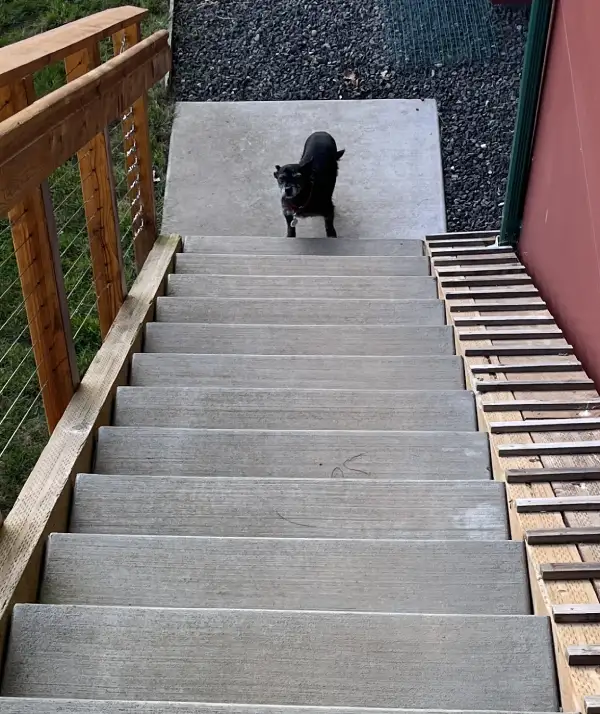
Once a puppy learns how to climb up and down stairs, they generally do so eagerly. As they age, however, their approach to stairs changes. It is normal for them to slow down and be more sedate in their approach to life in general, and stairs in particular. But if and when they begin actually hesitating at the top, bottom, or somewhere on the stairs themselves, there is a problem.
When a pet hesitates to do something that they have eagerly done in the past, they are showing they remember something happened that they don’t want to repeat. In other words, their back has started to hurt when they do the stairs, and now they are hesitating because they know that when they go up and down the stairs it’s going to hurt. They know they must go up and down stairs in order to get something they want (food, love, bedtime), but they are hesitating.
The degree of hesitation is going to vary based on the degree of pain the dog is experiencing. The worse the pain, the more the hesitation. Dogs will eventually completely refuse to do stairs if their pain becomes severe enough.
Note—Consider placing a baby gate at the bottom of the stairs to discourage unnecessary trips up and down the stairs through the day. This is discussed more thoroughly in the article Preventing Pain and Discomfort in Senior Dogs.
Not Jumping into the Car or onto the Bed
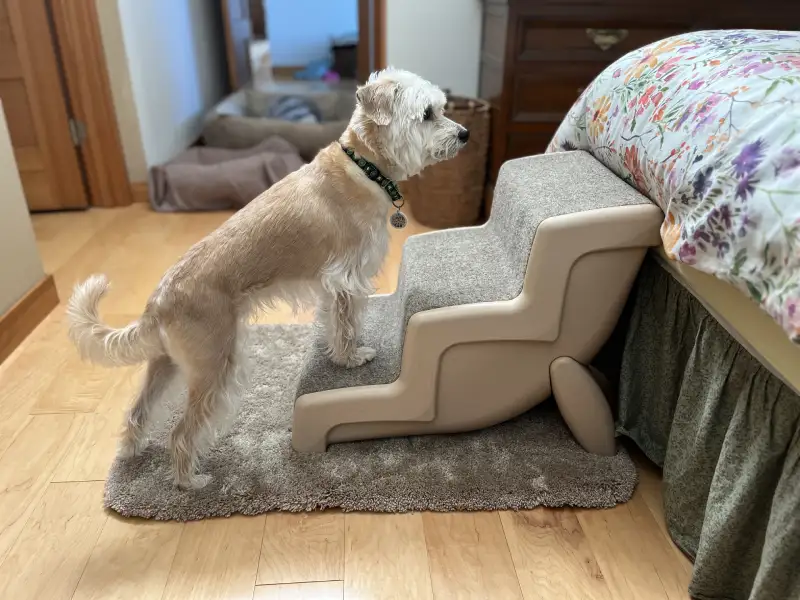
Pets will often demonstrate pain by not jumping onto the furniture or the pet owner’s bed. Pets may show hesitation before attempting to jump, or hesitate and then turn away. These are behaviors that pets often used to do eagerly, that they no longer do as they learn that they cause pain.
The same is true of getting into and out of the car. This is going to vary of course based on vehicle height and whether or not the dog jumps in and out or is lifted.
Postural Changes
Dogs will often show changes in their posture when they are experiencing pain. These postural changes often get missed but can be noticed with some attentiveness by the owner.
A curved or hunched-back appearance can mean a dog is experiencing pain. Most often this is from abdominal pain or spinal pain. (This can be one of the signs of gastric torsion or bloat, so it is wise to be familiar with that syndrome as well since it is life-threatening. A hunched back in combination with a distended abdomen or stomach area requires a fast drive to the nearest emergency clinic, because gastric torsion is the most likely syndrome in that situation. Note—always call ahead if you need to go to the emergency clinic so they are expecting you).
Occasionally pets will present in a “C” shape, where their spine and/or neck is curved to the right or left. This is usually spinal pain and can respond well to chiropractic as well as medical treatment.
Holding their head low and not meeting the owner’s gaze often signifies neck pain. This usually also responds well to chiropractic and medical treatment.
Advertisement
Positional Changes
One of the most obvious positional changes that show a dog may be in pain is when they are getting up and down from laying or sitting. If they no longer bounce right up from a down or a sit, or struggle to get their feet under them in order to rise, they may have pain in their knees, hips, hindquarters, and/or back.
Dogs often have undiagnosed knee injuries, particularly cranial cruciate ligament injuries. Such dogs have a particular way of sitting. They tend to sit carefully, and once they are sitting, they arrange their injured leg slightly in front of them and out to the side. This appears to be the most comfortable way for them to sit.
When getting up, dogs with painful knees often do so slowly and keep their injured knee turned out slightly, sometimes only touching the toes to the ground. When this particular posture is seen, the dog should be evaluated for a cranial cruciate ligament rupture as well as a general evaluation and pain assessment.
Shifting positions can be a sign of pain. A comfortable dog settles down for rest and sleep. When a dog shifts repeatedly, or won’t settle into a relaxed sleep, it can be a sign that they are painful and can’t get comfortable. A veterinary consult and discussion of their restlessness and sleep habits is indicated. Restlessness can also be a sign of canine cognitive dysfunction, which can be treated in many cases.
Attitude Changes
Just like in people, pain can make dogs grumpy, and could manifest in being snappy with family members, including both humans and other pets. Increasing grumpiness could signify they are in pain and could benefit from a veterinary consult and pain management plan.
Advertisement
Decreasing Desire for Exercise
Older pets often have pain that gets worse with exercise. Typically, owners describe their pets walking slower on walks, and wanting to turn around towards home sooner than they used to. Sometimes the dog might lie down on their walk and want to rest for a while.
Owners should try to note if certain behaviors have been extinguished due to pain that has developed over time. Pain may be making them reluctant to show their old behaviors, such as exuberantly running to the door, showing excitement to go for walks, or running to get their ball or toy. Voluntarily rolling over and stretching often stop as dogs develop arthritis pain.
Review
There are many ways that dogs show their pain, of which limping is only one. When dogs hesitate to do something, they are showing that when they did that behavior previously, it hurt them.
Changes in posture, position, attitude, and desire for exercise can all signify pain. Pet owners can learn a lot about how their dogs are feeling by observing them closely.
Please read the PHH article Preventing Pain and Discomfort in Senior Dogs to find out what you can do to keep your dog healthy and comfortable throughout their senior years.

By Karen E. Mueller DVM, AVCA Certified
Dr. Mueller has over 30 years of experience in general small animal veterinary practice, feline medicine, and shelter medicine. Dedicated to preventing pain in pets and improving their quality of life, she currently has an animal chiropractic practice in Bellingham, WA. Dr. Mueller is also passionate about reducing pet overpopulation and works with high-volume, low-cost spay and neuter nonprofit programs throughout the Pacific Northwest.