
 Pet News


Summary
This article explores the unique aspects of canine vision, emphasizing its differences from human sight. While dogs have lower visual acuity, they excel in low-light vision due to more rod photoreceptors and a reflective tapetum layer, aiding in night vision.
Dogs’ motion sensitivity and Field of View (FOV) vary across breeds, influenced by eye placement and skull shape, which also affects their depth perception. Their color vision is limited to shades of blue and yellow, but they are skilled at distinguishing various shades of gray. This specialized vision aligns with dogs’ natural behaviors and is essential for their interaction with the environment.
The article highlights the importance of recognizing and catering to these differences in canine vision for their overall well-being.
Introduction
The question of how well dogs see may seem simple, but it’s more complex than it appears. Vision in dogs, and in all animals, differs from human vision in several key ways. First, animal vision is influenced by various factors which vary among the different species. Second, the eyes serve as information receivers, sending data to the brain for interpretation. In essence, all animals, including humans, “see” with their brains, not just their eyes.
Visual Acuity in Dogs
When we assess vision in humans, we often focus on visual acuity—the ability to distinguish close objects clearly and without blurring. However, the complete visual experience comprises multiple components beyond visual acuity. These include light and motion perception, visual perspective, field of view (FOV), depth perception, and color vision.
Humans excel in visual acuity compared to most animals, leading us to falsely assume that our visual experience is superior. However, animals often outshine humans in these other components, making their overall visual experience impressive.
It is absurd to believe that a tiny camera attached to the head of an animal provides any information about what that animal understands visually. At most, such a camera offers a glimpse into the animal’s environmental perspective, but nothing more. It is essential to recognize that dogs and other animals perceive their environment through a rich and diverse set of visual components, making their visual world unique, fascinating, and perfect for their role in it.

Visual acuity, an essential component of vision for humans, is influenced by the eye’s optics, the retina’s light processing abilities, and the brain’s interpretation of visual information. While humans measure their visual acuity using the Snellen Eye Chart, this method isn’t applicable to animals like dogs. Their visual acuity is assessed through techniques like retinoscopy, similar to those used for infants or non-verbal humans.
This process involves determining the lens strength required to focus images on the retina. For comparison purposes, dogs typically have a visual acuity of 20/75, where they can see at 20 feet what a human with standard vision sees at 75 feet.
Animals cannot read eye charts, so their vision is assessed differently, often by observing their response to objects or threats. These tests, while not highly precise, evaluate motion sensitivity across the entire retina. As such, a positive response may still be present even in animals with visual acuity less than 20/800! Some breeds, notably Rottweilers and German Shepherds, are prone to near-sightedness.
Interestingly, police-trained German Shepherds are not near-sighted, as only those dogs unaffected by this trait are able to complete their rigorous training. Fortunately for dogs, detailed object distinction is less vital to their lifestyles compared to humans.
Advertisement
Superior Low-Light Vision in Dogs

Dogs have significantly better low-light vision than humans, largely due to their unique eye structures and photoreceptor types. Their eyes contain a higher number of rod photoreceptors, specialized for low-light vision, compared to the cones used for daylight vision and color perception.
The presence of a tapetum, a mirror-like reflective layer behind the retina, greatly enhances a dog’s ability to see in low light. This structure, which is absent in humans and some other animals, reflects light back through the retina, intensifying the light available to the rods. This is also what causes the bright “eyeshine” observed in dogs’ eyes at night.
Additionally, dogs’ also benefit from physical adaptations like a larger cornea, which allows more light to enter the eye to reach the retina and tapetum.
While both dogs and cats excel in low-light conditions, cats surpass dogs in this aspect. Dogs, though not as adept as cats, still have better night vision than humans. These evolutionary adaptations are essential for their nocturnal activities and hunting behaviors and understanding them offers valuable insight into the behavior of our pets.

Motion Sensitivity and Dogs' Peripheral Vision
Motion sensitivity differs significantly between humans and dogs, primarily due to the distinct composition of their retinas. In bright light, humans are better at detecting motion. This capability stems from the high concentration of cone photoreceptors in a specialized area of the retina known as the fovea.
The fovea, dense with cones, is crucial for day vision, color perception, and discerning fine details. Notably, this area is absent in both cats and dogs.
In contrast, dogs possess a retinal structure optimized for different conditions. Their larger cornea and broader peripheral visual field make them particularly sensitive to brightness and motion.
Dogs often overlook stationary objects in their peripheral vision. However, they show an instinctive response to moving objects. This behavior is attributed to the retina’s responsiveness to the motion frequencies typical of prey. As a result, a dog might ignore a motionless squirrel but become highly alert and animated when it starts to move.
This specialization in canine vision aligns with their natural behaviors and environmental interactions, particularly under varying light conditions. This may also explain why your dog might not see you standing motionless at a distance. This can be especially obvious if you are downwind from them and they can’t smell you, or far enough away that they cannot hear you.
Reduced detection of you is especially true if your dog is elderly and more likely to have reduced senses of small or hearing, or even reduced cognition.
Perspective and Height Differences in Dog Breeds
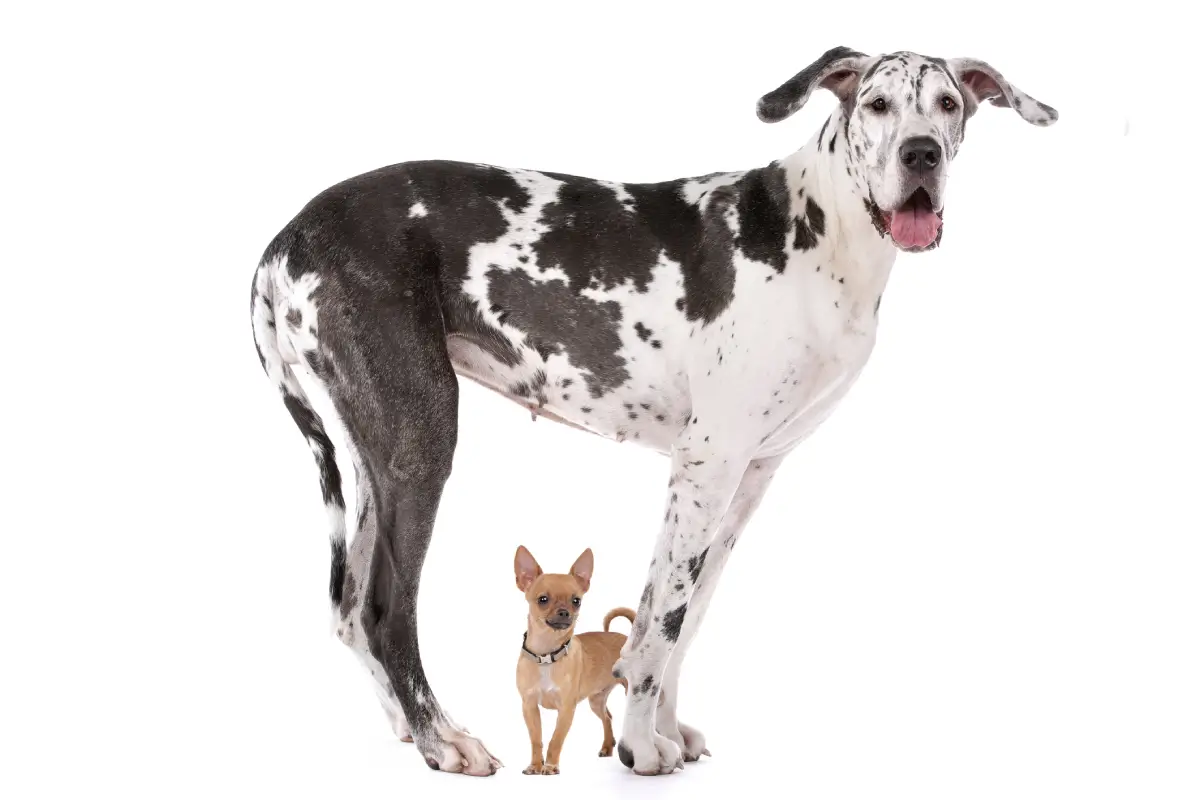
The perspective we have of our surroundings is greatly influenced by the height of our eyes above the ground. This variation is minimal within adult animal species (including humans) but varies significantly between different breeds of dogs! This contributes not only to a varied interpretation of the environment, but also to some behavioral traits. What might appear as dense brush to one dog, is perceived as short grass to another.

Field of View and Depth Perception in Dogs

Field of View (FOV) refers to the visible area observed by one or both eyes when focusing on a single point. It’s categorized into monocular, binocular, and total FOV. Dogs exhibit significant variation in FOV. These differences are related to breed-specific skull shapes and eye placement.
Short-nosed breeds, with laterally oriented eyes, like Boston Terriers, have eyes positioned wider apart, leading to a wider FOV. Long-nosed breeds like German Shepherds have more forward-facing eyes with a narrower FOV but a wider binocular overlap for better depth perception.
In dogs, the binocular overlap (stereopsis)ranges between 30-60 degrees which is comparatively lower than in humans and cats, where it averages 140 degrees. Stereopsis, the fusion of two slightly different images from each eye into a single image, enhances depth perception, it is not the only contributing factor.

It is a common misconception that depth perception is solely dependent on having two eyes. Depth perception can be achieved even with one eye, through various other elements such as relative brightness, contours, light and shadow areas, object overlay, linear and aerial perspective, and the density of optical textures.
A good illustration of this is a high-quality 2D chalk sidewalk drawing, where depth is perceived through these factors without the need for binocular vision. This concept is important in understanding the visual perception of animals like dogs, which may have different degrees of binocular overlap and rely on these multiple factors for depth perception.
Advertisement
The Role of Motion Parallax in Depth Perception

Another factor that contributes to depth perception is motion parallax. Motion parallax is a phenomenon whereby a closer stationary object is perceived to move faster than a farther stationary object, as experienced when driving a car: nearby telephone poles seem to move swiftly in the opposite direction of travel, while distant mountains appear stationary.
This effect is a result of the poles being closer to the observer than the mountains, making them appear to move faster. All animals, including humans, subconsciously use motion parallax to judge distances but it becomes more evident in animals with eyes spaced further apart like those in cows and rabbits.
Advertisement
Canine Color Vision

Color vision in dogs differs from human color perception. Unlike humans, dogs have only two types of color receptors and predominantly see less saturated (milky) tones of blue and yellow while reds and greens are perceived as shades of gray. Additionally, dogs have a unique capability to differentiate closely related shades of gray, especially in a neutral point in the blue-green range, which are indistinguishable to the human eye. This ability is more advantageous in low light levels, where color perception is less relevant.
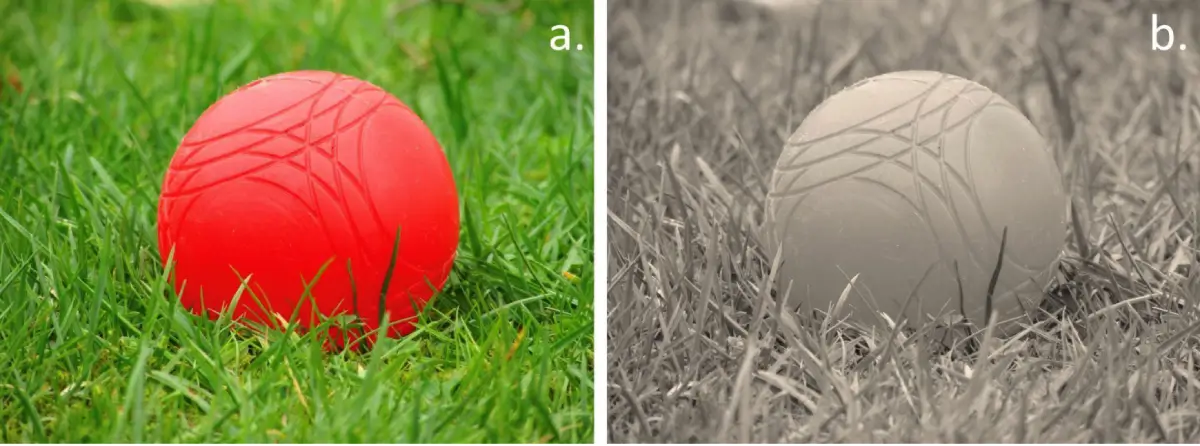
In practical terms, reduced color vision in dog’s results in the reliance on other cues to identify objects. For example, a dog is unable to discern a red ball in green grass by color alone but would be able to discern the ball based on texture, position, brightness, smell, and taste. This reliance on non-color cues is also important for guide dogs, who cannot distinguish traffic lights based on color; instead, they are trained to recognize the position and brightness of the lights.
Overall, while dogs do have color vision, it is significantly different and less varied than human color perception, leading them to rely more on other senses and cues in their environment for identification and navigation.
Conclusion
Vision is a critical aspect of the lives of all animals, including dogs, aiding them in interacting with and thriving within their respective environments. Each breed has evolved a unique visual experience that is tailored to its specific ecological niche, making it impossible to rank or compare overall visual capabilities.
What is ideal for one species may not be for another, as each has adapted its vision to meet its specific needs and environmental challenges. For instance, the vision of a dog is not inferior to that of a human; it is perfectly suited for what dogs need to see and how they need to see it.
Similarly, while dogs do not perceive fine detail or the same variety of colors as humans do, they do have superior abilities to detect motion, see in low light, and use their exceptional senses of smell and hearing to interpret their surroundings. Understanding these differences is crucial, as it underscores the importance of caring for the eyes of our pets and seeking veterinary attention when necessary. By appreciating and catering to the unique characteristics of our dogs’ vision, we can ensure they lead fulfilling and healthy lives.
For further information please visit How and What Animals See, and How and What Cats See where we will explore the same concepts as those above but in greater detail, as well as Vision in Dogs (1995) Journal of the American Medical Association, 207(12): 1623-1634 by Miller PE and Murphy CJ.

By Marnie Ford PhD, DVM, Diplomate ACVO
Dr. Ford graduated from the Ontario Veterinary College in 2000 after completing a Bachelors in Zoology at the University of British Columbia and a PhD in Physiology at Monash University in Australia. Following a rotating small animal internship at the University of Minnesota in 2001, Dr. Ford achieved Diplomate status from the American College of Veterinary Ophthalmologists in 2006 after completing a 3-year residency in Comparative Ophthalmology at the University of Missouri. After co-founding a private referral hospital, West Coast Veterinary Eye Specialists, in New Westminster (2004-2013) she opened Pacific Animal Eye Specialty services, providing mobile medical and surgical ophthalmologic care to patients in the Lower Mainland, Vancouver Island, and the Interior of BC (2013-2019). In 2019, she returned to Australia where she worked full-time in both medical and surgical ophthalmology as well as resident training at Animal Eye Care in Melbourne Australia. In 2023, Dr. Ford returned to Vancouver to provide locum services to ophthalmologists across Canada.